 Facebook
 X
X
 Pinterest
 Copy Link

PHOTO: JULIA GARTLAND; FOOD STYLING: SAM SENEVIRATNE



Mortgage rates continue to hover in the mid-6% range, with the 30-year fixed-rate mortgage rising to 6.37% this week, Freddie Mac reports. However, the higher borrowing costs are not affecting all home buyers equally this spring.
Bright MLS Chief Economist Lisa Sturtevant points to a growing divide in the housing market. “Equity-rich, higher-income households are less rate sensitive and are more likely to take advantage of expanding inventory to make a purchase this spring,” she says. “The other group includes first-time buyers and lower-income households who are feeling more economic uncertainty and the strain of rising mortgage rates.”
Economists increasingly describe this as a K-shaped housing market, where activity remains stronger at the higher end while entry-level demand slows under affordability pressure.
Sturtevant also notes that rising rates are influencing who is willing—or able—to list homes this spring. “We are going to see new listing activity driven by those who need to move out of necessity—family or job changes—while discretionary or optional moves will be put off, particularly by those homeowners currently holding sub-4% mortgage rates,” she says.
Recent rate increases are prompting some would-be buyers to hold off. Mortgage applications for a home purchase fell 4% last week, though applications remain 5% higher than the same week a year ago, according to the Mortgage Bankers Association.
“The ongoing conflict in the Middle East continues to push rates higher,” says Joel Kan, deputy chief economist at the MBA.
At the same time, still-rising home prices is prompting the average loan size for a mortgage to climb to record highs. The average purchase loan application climbed to $467,300 in the latest week—the highest level in MBA’s survey history dating back to 1990.
“This increase could indicate that potential first-time buyers, and buyers looking for homes at lower price points, might be more hesitant to move forward given the economic uncertainty and higher rates,” Kan says.
New Doors Are Opening:
Buyers may find more opportunities lately in the new-home market.
“Recent data points to slightly better conditions for buyers with a boost in new-home sales, median new-home prices being down to their lowest level since July 2021, and higher inventory than in recent years,” says Sam Khater, Freddie Mac’s chief economist.
He adds that these trends may help “modestly ease affordability pressures” for some buyers during the spring homebuying season.
Sales of newly built single-family homes rose 7.4% in March compared to February and were up 3.3% from a year earlier, the Commerce Department reported earlier this week. Builders cite tight supply in the existing-home market as a key driver of demand for new construction.
The median new-home sales price in March was $387,400, down 6.2% from a year ago and nearly 10% below its most recent peak in December 2025.
By comparison, the National Association of REALTORS® reports the median price of an existing home sold in March was $408,800—about $21,000 higher than the median new-home sales price.
Freddie Mac reports the following national averages with mortgage rates for the week ending May 7:

I’ve made a lot of no-bake desserts in my time, and this is easily one of the top 5 pies I’ve ever made. It tastes just like a melted strawberry milkshake, in the absolute best way possible. A shortbread cookie crust supports the creamy, strawberry-studded filling, and a homemade whipped cream completes the milkshake look. When it’s too hot to turn on your oven, but you need a sweet treat, this is the simple summer dessert you should make. Read on for my top tips on how to get it just right.
Though this pie is no-bake, it’s not no-cook, but it’s still pretty simple to throw together. Cooking down the strawberries helps them combine more easily with the other filling ingredients, so don’t be tempted to cut that time short. You can always do this a day or two ahead of time if you need. A little gelatin and cream cheese help give this pie its structural integrity (plus the latter adds a delicious tang that pairs well with the strawberry flavor).
I kept the homemade whipped cream unsweetened, because I like the contrast between it and the sweet pie, but feel free to change it up. You can add 1 to 2 Tbsp. confectioners’ sugar if you like, or go straight for the Reddi-wip if you really want!
1 (11.2-oz.) pkg. shortbread cookies
Kosher salt
5 Tbsp. unsalted butter, melted
20 oz. fresh strawberries, quartered
1/4 cup (50 g.) granulated sugar
1 Tbsp. fresh lemon juice
1 (1/4-oz.) packet gelatin
1/3 cup boiling water
3/4 cup heavy cream
1 (8-oz.) pkg. cream cheese, softened
1 cup sweetened condensed milk
1/2 cup heavy cream
4 fresh strawberries, halved
A piping bag, a small star tip

As California observes Wildfire Preparedness Week, May 3–9, 2026, CAL FIRE and partner agencies across the state are engaging communities to highlight the importance of readiness, resilience, and coordinated wildfire response ahead of heightened wildfire activity. As part of this effort, CAL FIRE and County of Los Angeles Fire Department today hosted a regional news conference in Southern California in Calabasas to spotlight the region’s unique preparedness needs and showcase the partnerships that support wildfire response and mitigation both locally and statewide.

“Southern California’s wildfire challenges require year-round readiness and strong partnerships,” said CAL FIRE Director and Fire Chief Joe Tyler. “This event highlights the dedicated people, equipment, and planning already in place to protect our communities.”
This year’s Wildfire Preparedness Week encourages Californians to take proactive steps to protect their families, homes, and neighborhoods—creating defensible space, hardening structures, staying informed, and preparing evacuation plans in advance.
For additional preparedness resources, visit ReadyForWildfire.org. For additional Wildfire Preparedness Week Resources, check out the Media Toolkit.
Residents are also encouraged to use CAL FIRE’s Ready for Wildfire web-based app, which provides customized checklists, local alerts, evacuation planning tools, and more. The free app is available at: plan.readyforwildfire.org.

David Hasselhoff became a household name as Michael Knight in Knight Rider and later as Mitch Bucannon in Baywatch, earning millions from the latter that allowed him to purchase a large home in Calabasas. But long before that, he lived in a far more modest house.
In 1979, he appeared in a set of photos captured inside his home. In one shot, the actor, now 73, was seen relaxing on his bed, reading a copy of Semi-Tough by Dan Jenkins. The bedspread featured a dark brown pattern made from velvet that clashed with his chevron print curtains.
 © Getty Images
Nostalgia is making its way back into interior design trends, and David’s layered pattern aesthetic fits the bill. Interior designer Carlin van Noppen told Homes & Gardens of the space: “The accelerated trend cycle means that formerly ‘dated’ looks like chevron are likely to come back much sooner than they may have in the past. However, I don’t necessarily see chevron as a ‘trendy’ pattern; with the right treatment, it can be as timeless as stripes. It’s always popular in design circles, because subtle chevron is always chic.”
 © Getty Images
Though there is a certain appeal to David’s 70s vibe, his living room is a far cry from his primary home now. The actor resides in California in a house that he and his daughter, Taylor Hasselhoff, attempted to sell for $3.6 million while appearing on Impossible Listing in 2020.
However, the duo was not successful in offloading the property. The grand Mediterranean-style home was situated on a hill and featured three balconies. It sits across 1.5 acres and boasts a lagoon-style pool, a spa, and an outdoor kitchen.
 © Corbis via Getty Images
Photos published by Today reveal that David’s bolthole features five bedrooms and six baths, including a master suite with a fireplace, as well as a large walk-in closet and what the listing once described as a “sexy” bathroom.
In 2017, David extended his portfolio to include an international property, purchasing a beachfront home on the island of Gili Meno in Indonesia. The seaside abode is part of a resort development on the island, which is situated off the east coast of Bali.
 © Jeff Kravitz
It features a bar, as well as a sunbathing terrace, an infinity pool with breathtaking sea view, and direct access to one of the island’s beaches. “I love Gili Meno as there are no cars on the island, it is like going back in time,” The Hoff said of his investment at the time.
“The best thing about the island is that you can eat out so well, such as fresh lobster, and it costs next to nothing.”

The U.S. Green Building Council (USGBC) announced the 2026 cohort for its LEED for Cities certification program. The cohort includes 17 cities from across the U.S. that are committed to certification under the LEED v4.1 Existing Cities rating system. The program, supported by longtime partner Bank of America, helps to institutionalize and operationalize sustainability in local government through the LEED for Cities certification process.
Local governments are navigating extreme weather events, all while facing their own resource constraints. LEED for Cities provides a proven framework and roadmap for local governments to advance sustainable development and implement comprehensive sustainability strategies that improve health and quality of life while reducing waste and negative environmental impacts.
“Local governments are a driving force behind creating more sustainable, healthier communities for all residents,” said Peter Templeton, president and CEO, USGBC. “Through the LEED for Cities certification program, these forward-thinking municipalities are setting ambitious goals, measuring their progress, and demonstrating leadership in improving community health, efficiency, resilience, and livability. The 2026 cohort represents a diverse set of cities united in their commitment to creating a better future.”
The LEED for Cities Certification Cohort is a component of USGBC’s Local Government Leadership Program, which provides in-person leadership summits, peer learning opportunities, technical assistance, and ongoing support to cities and counties across the country.
“The LEED for Cities Cohort provided valuable structure and support, especially for small sustainability teams like ours,” said Alex Pharmakis, sustainability manager for the city of Farmers Branch, Texas, a 2025 cohort participant. “With practical resources and access to a strong network of peers, the program simplified our path to certification.”
Local governments can certify in LEED for Cities on their own, but some choose to participate in the cohort for the camaraderie and competition that comes with a group effort. Participants meet monthly in group settings where they troubleshoot data issues, share concerns, and inspire one another to reach the finish line. Project management resources provided to participants help them reach milestones and ultimately submit their certification application for review by the end of the program year.
The 2026 cohort includes 17 local jurisdictions across the U.S. representing 2.5 million people:
In partnership with the Bank of America, the LEED for Cities certification program has provided direct support to nearly 140 U.S. local governments, representing 58 million people, since 2017. Since 2011, the Bank of America Charitable Foundation has contributed more than $4.55 million in total grant funding to USGBC to support its work advancing sustainable buildings and communities. Bank of America has also demonstrated leadership in green building within its own operations through the achievement of LEED certifications across its global portfolio. More than 33% of the bank’s occupied real estate has achieved green building certifications, and the company aims to achieve certification for 40% of its building space by 2030.
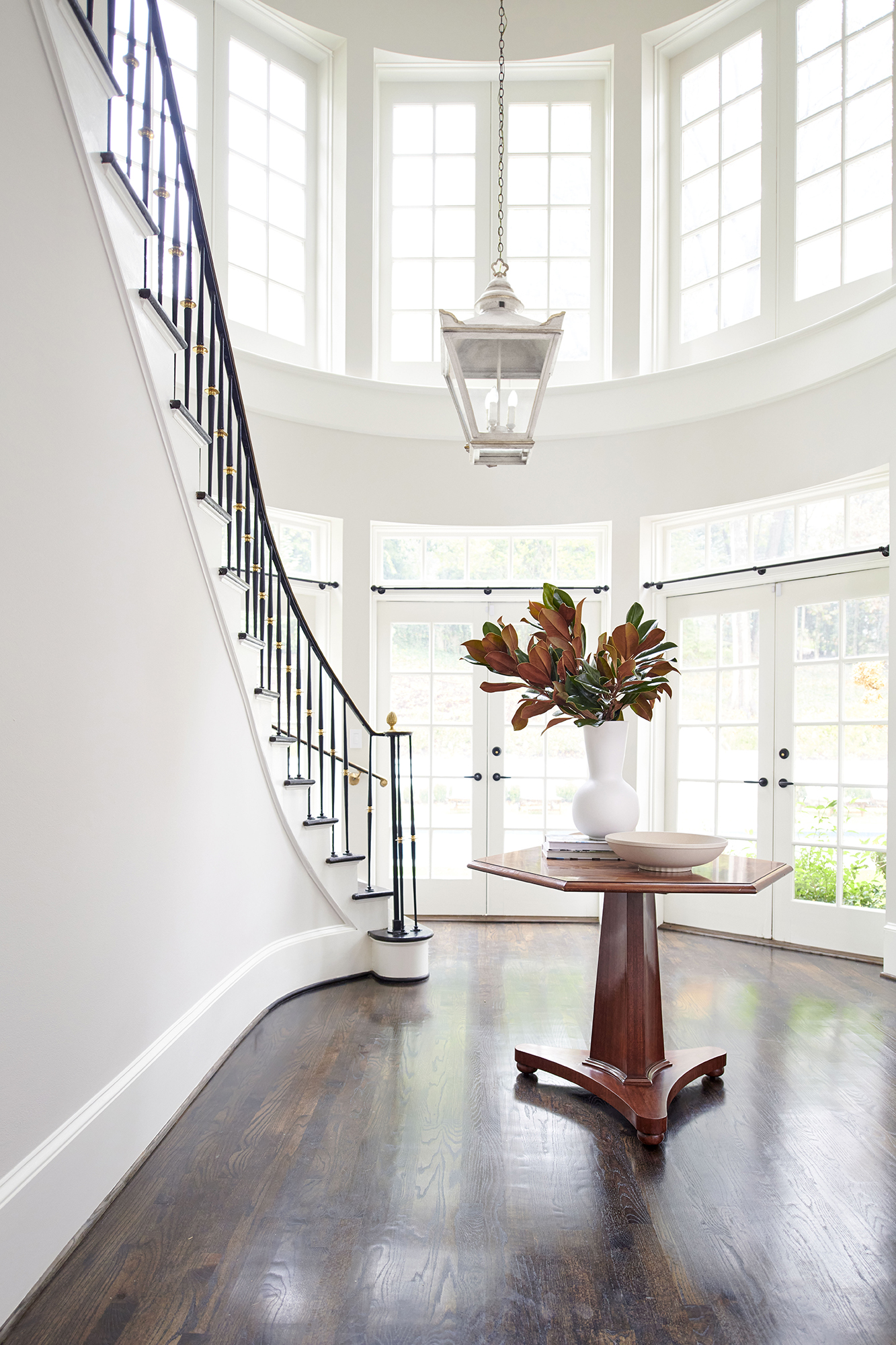
You may have heard April 12-18 was the “best week” to list your house. That’s based on a report from Realtor.com. But now that it’s passed, you may be wondering if you missed your moment.
Here’s the good news – you didn’t.
Because the reality is, there isn’t just one perfect week to sell your house this Spring. There’s a window. And right now, you’re still in it.
Here’s why. Different organizations run studies like this every year. And they don’t always land on the exact same week. That’s okay. It’s because they’re using different research methods and even different definitions of what “best” means.
But the fact that the results vary points to a larger trend. While there may be sweet spots, the entire Spring season gives sellers an opportunity to get some of the best conditions (and best sales prices) of the year.
And it’s definitely not too late to jump in.
According to Zillow, the best time to list your house this year is the last 2 weeks of May. And that’s approaching fast.
Based on their analysis, this is the ideal time to do it if you want to make top dollar. Because, in this 2-week window, homes sell for more. Sometimes, quite a bit more.
Depending on where you are and the price point in your area, some homeowners may even net tens of thousands of dollars extra in this sweet spot. As Zillow explains:
“Why late spring? Buyer demand typically peaks before Memorial Day. Families want to move during the summer and settle in before the new school year. More buyers shopping at once can spark competition and lift prices.”
And they’re not the only ones saying listing in May could be the key to selling for more. ATTOM Data analyzed almost 52 million home sales over the past 10 years and found sellers in May are achieving some of the highest returns.
That means the ideal window this year is very much still open.
If your goal is to sell for the strongest possible price, this is where timing and strategy come together. And you want to be sure you’re ready to make the most of it.
So, what should you be doing right now?
When prepping for a fast-moving window like this, you don’t want to waste time or money on the wrong prep work. And your agent is your go-to to make sure you’re focusing on the right things.
They’ll be able to tell you if the “best week” is slightly different in your market. And what quick repairs or updates can help you get a higher price, without taking a ton of time or effort.
Here’s a quick example of things an agent may recommend based on information from Redfin:
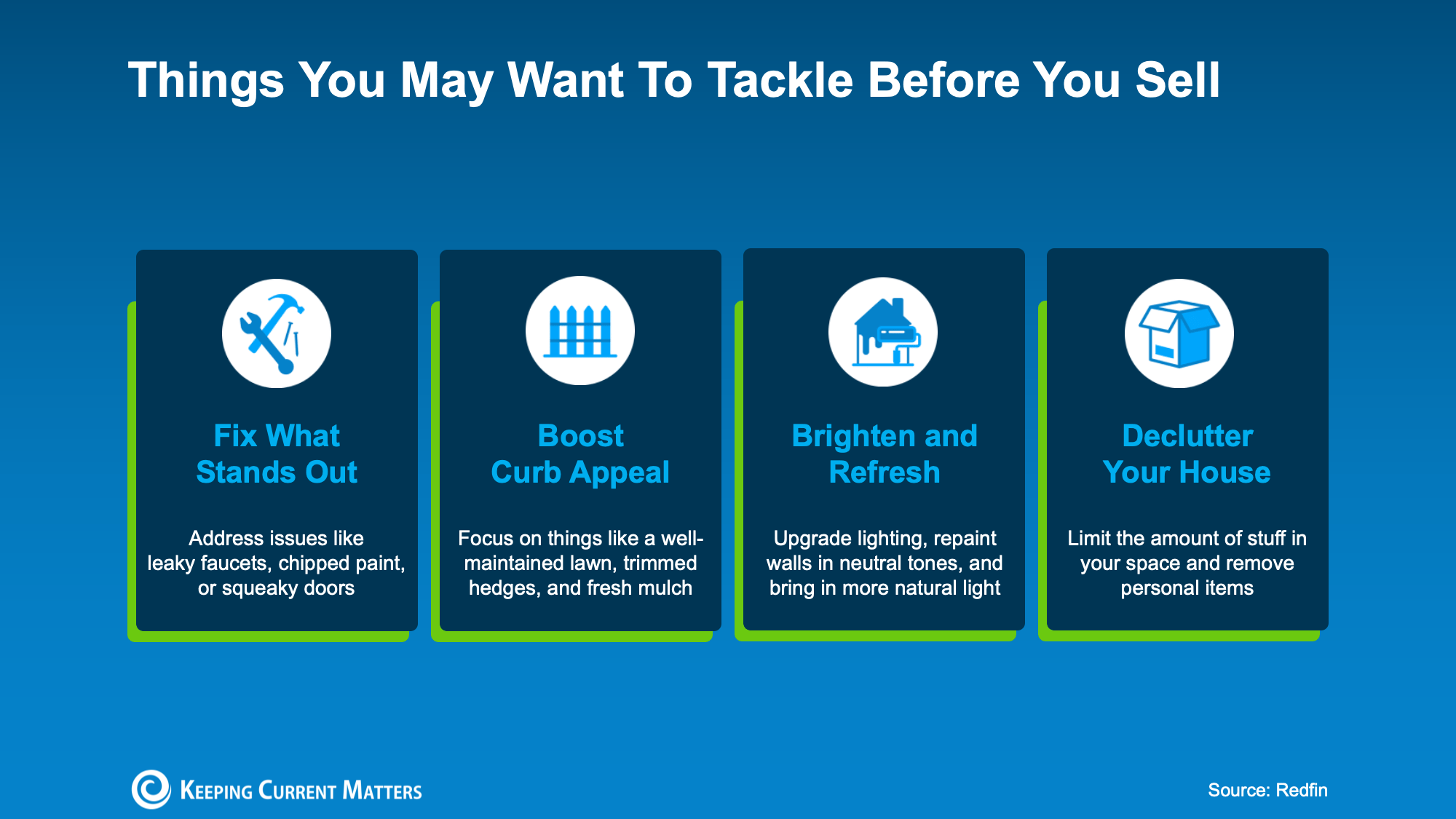 At the end of the day, when your prep time’s short, doing the right things matters more than doing more things.
Zillow says the best time to list your house is just around the corner. Are you ready to make the most of it?
If you want to take advantage of this Spring sweet spot and get top dollar for your house, talk to us about what you need to do now to get ready to hit the market.

LOS ANGELES, CA — The owners of a custom-built mega mansion in Bel Air are asking $400 million for the property, which if sold at that price would make it the country’s most expensive residential sale ever.
Dubbed “the Crown Jewel of Los Angeles” by its listing agents, the home at 11201 Chalon Road was completed around 2018. The estate boasts 70,000 square feet across multiple structures and its perched on an 8-acre hilltop lot offering expansive views of the Pacific Ocean, Bel Air Country Club, downtown Los Angeles and beyond, according to the listing, which is held by Jack Harris and Michael Fahimian of the Beverly Hills Estates.
The main home — which totals 50,000 square feet — features 10 family bedrooms and 13 staff bedrooms. The 30,000-square-foot guest house includes six guest bedrooms and 10 staff bedrooms. There are 39 bathrooms across the property, as well as three swimming pools.
There’s also a hammam — a kind of steam bath — an x-ray room, tennis court and pavilion, salon, theater, safe room, restaurant-style kitchen and art storage space.
The estate “was designed so that you don’t ever have to leave if you don’t want to,” Fahimian told the Wall Street Journal.
Building the estate was a complex labor.
The design was led by famed architect Peter Marino, while Peter McCoy steered the construction.
The property is owned by an entity tied to Qatar’s ruling Al-Thani family, which paid $35 million for a 7.8 acre site in 2010. It took about 10 years to complete at a cost of more than $350 million, the Journal reported.
Property taxes total $1.4 million a year. If it sells for $400 million, closing costs would be about $40 million, according to the Journal.
“There’s a handful of people who can afford something like this,” Harris told the publication.
Few homes have sold for above $200 million in the U.S. — let alone close to $400 million.
The record is held by the $240 million hedge-fund manager Ken Griffin paid for a New York City apartment in 2019, according to the Journal.
Jay-Z and Beyoncé set California’s record in 2023 when they paid $200 million for a Malibu estate perched right above the beach.
A mystery buyer bested that record the following year with the purchase of a $210 million Malibu property from Oakley founder James Jannard.

Italy is serious about lemons. When was the last time you thought about the varietal last time you bought a lemon? Beyond “yellow” and “round,” there isn’t too much to think about when you’re shopping for citrus at the American grocery store. Southern Italy is especially well known for its lemons, and Sicilian lemons are famous for their taste and essence. The bright flavor of lemons goes well with many savory dishes, including Linguine with Lemon Garlic Sauce and Garlicky Beans with Lemon Dill and Trout.

Since we saw Stanley Tucci sniffing lemons in “Searching for Italy,” we’ve had citrus on the brain. Traditional pasta al limone with asparagus is a popular dish in southern Italy, and even though it’s a cream-based sauce, it’s nice and light because of the zesty citrus. Recipes for lemon pasta call for a variety of cheese–from fresh ricotta to aged Parmigiano Reggiano–and we like to use pecorino Romano for its sharp saltiness. Our pasta al limone recipe also includes asparagus, because why not?

Pasta – This recipe is best with long noodles like spaghetti or cult classic bucatini.
Asparagus – When it’s good, it’s so good. And asparagus cooked quickly with garlic is just delicious. You could also use leftover Grilled Asparagus, if you have it.
Lemon zest – Makes so many things taste *that* much better, like Shishito Peppers!
Heavy cream – We don’t call for heavy cream unless it’s worth it, and we’ll just say, it’s really worth it in this sauce for pasta al limone.
Pecorino Romano – Folks often use Parmigiano Reggiano and Pecorino Romano interchangeably, and with good reason. They’re both sharp, a little salty, and super dry. For this lemon spiked pasta, we think that Percorino Romano plays better with the lemon, but feel free to substitute parm if it’s what you have on hand.




Cook the pasta. Bring a large pot of salted water to a boil over high heat. Add the pasta and cook until al dente. Reserve a cup of the starchy and salty pasta water to add to the sauce.
Cook the asparagus and garlic in a large saucepan.
Make the sauce. Stir in the pepper, lemon zest, heavy cream, and salt. Add in the butter, and stir until melted and the sauce has thickened. Remove from heat.
Stir in the pasta. Add the pasta to the sauce along with the parsley, basil, cheese, and reserved pasta water. Stir until the pasta is coated and the cheese is mostly melted.
Serve! Divide the pasta between bowls and sprinkle with more grated pecorino Romano, lemon zest, and a few more turns of freshly ground pepper.

If we’re following tradition, this pasta al limone, would be eaten while hot. All of it, with nothing going into the fridge or freezer for future pasta cravings. This isn’t one of those pasta dishes that freezes well. We’ll direct you over to our Classic Lasagna Recipe if you’re looking for something that freezes well!!
When life gives you lemons, zest them. It seems intuitive, but we were today years old when we discovered that you use your dominant hand to move the citrus zester over the surface of the lemon, and not the other way around. You can definitely move the lemon over the zester, but you won’t have as much control over the zesting.
Reserve the pasta water! This is something we’re getting more accustomed to doing. It helps to add body and to season the sauce. It’s easy to control the amount you’re using, which will also help you get a better feel for the technique, with a glass measuring cup.

There’s a lot of uncertainty right now and that’s leading to some dramatic headlines. And if you’re thinking about buying a home, that can make you feel a little less sure about your decision.
A recent study by CNBC asked homebuyers what they’re most worried about, and three themes kept coming up again and again:
But a lot of what you may be hearing on those is based more on misconceptions. Not facts. So, let’s break it down and separate fact from fiction.
One idea doing its rounds on social is that mortgage rates are going to drop dramatically soon. So, it’s better to wait to buy.
But is that really what’s expected?
While mortgage rates have come down a bit in the last few weeks, forecasts don’t show a major drop ahead. The most likely scenario is that rates stay somewhere in the low 6% range this year.
And that’s not a big change from where rates are now (see graph below):
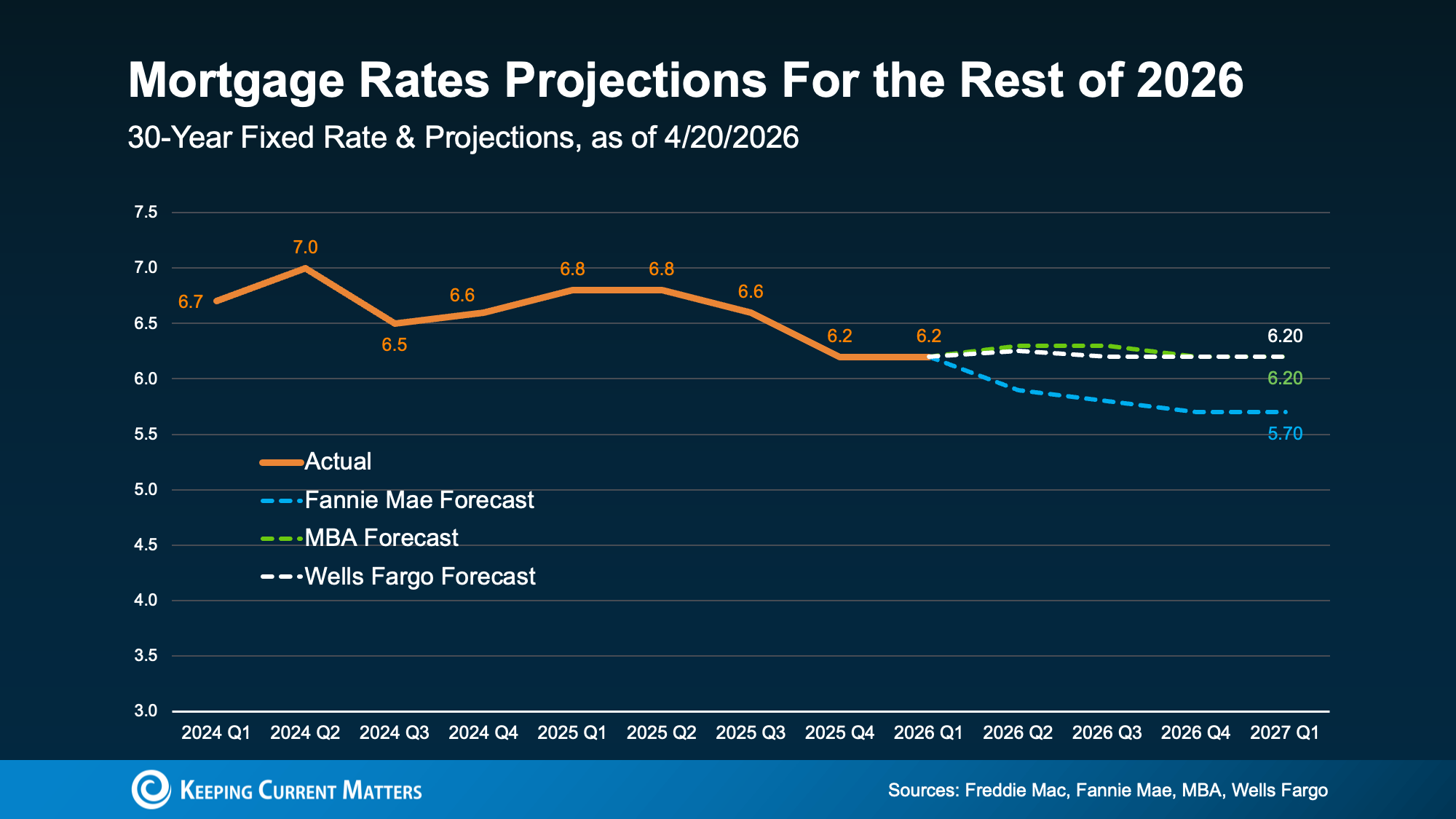 Of course, this depends on where inflation and the economy go from here. But, based on what we know today, waiting for a big drop in rates may not work out the way some people hope. As U.S. News explains:
“Mortgage rates aren’t expected to change much over the next several quarters . . .”
Not to mention, even with rates where they are today, it’s already more affordable than a year ago. So, even if they don’t change much, it’s still better than it was.
You’ve probably heard inventory is up. And nationally, it is. The number of homes for sale is 8% higher than this time last year. But that’s not a bad thing. In fact, it’s one of the reasons buyers have a bit more breathing room right now.
The problem is the headlines are making something good, sound bad. They’re focusing on how this is the most inventory we’ve had since 2019 or how many homes builders are building. And that can make it sound like the number of homes for sale is rising too far, too fast.
But that’s not what the bigger picture shows.
Data from Realtor.com proves that, even though inventory is up compared to last year, it’s still nearly 14% lower than it was during the last normal housing market (2017-2019):
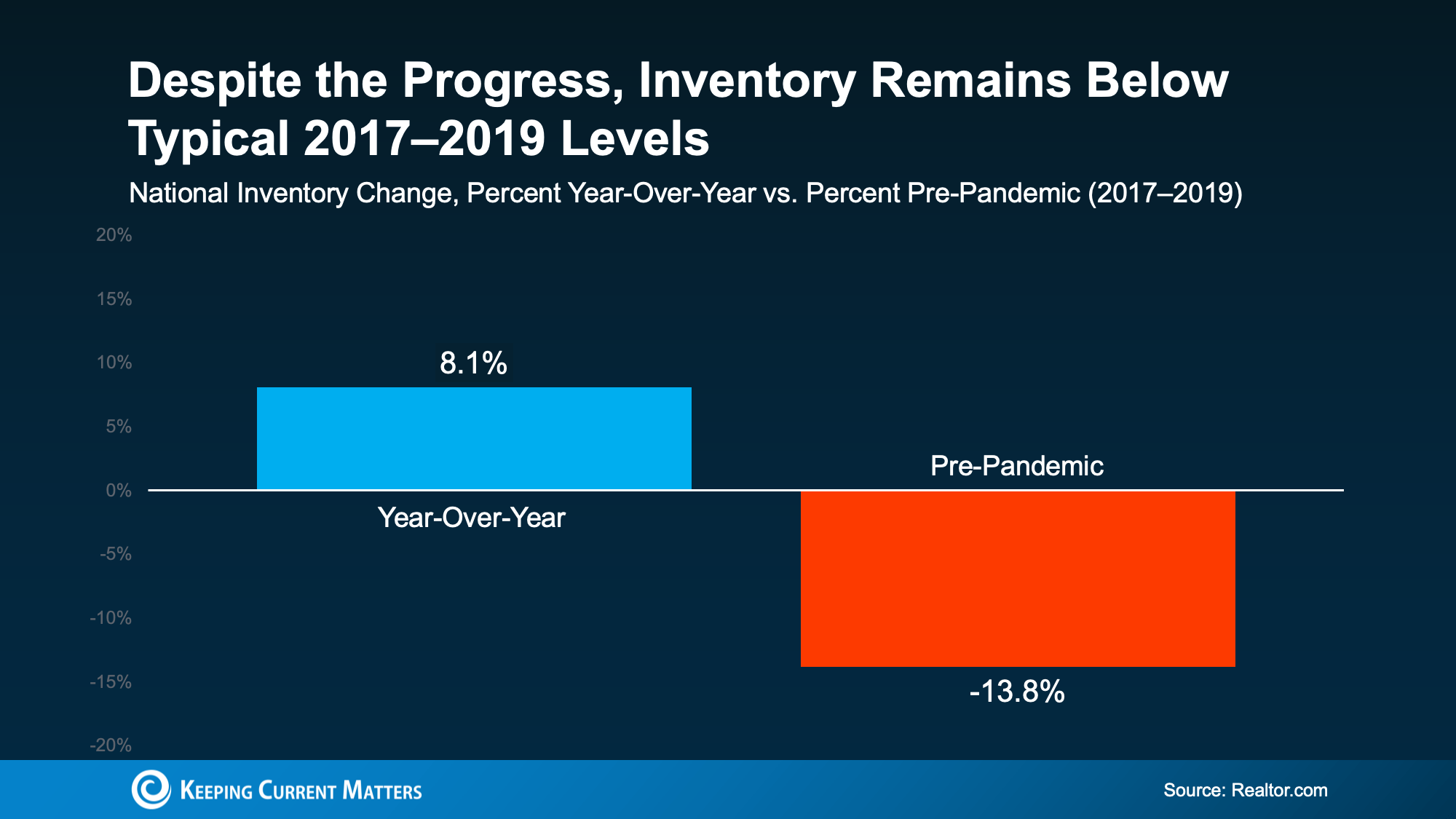 While it can vary a lot based on where you live, only 9 states have more inventory than pre-pandemic today. That’s a key reason why there still aren’t enough homes for sale to trigger something like the crash back in 2008.
You’ve probably seen this one, too. The confusion is coming from the fact that some metros are experiencing slight price declines. And influencers are running with that and saying prices are crashing. But that’s not the reality.
Most areas are seeing prices rise, not fall. And that’s because:
And those are 3 big reasons prices aren’t headed for a crash.
And even in the markets experiencing mild declines, the drops aren’t enough to cancel out the big gains most homeowners have seen in the last 5 years (see graph below):
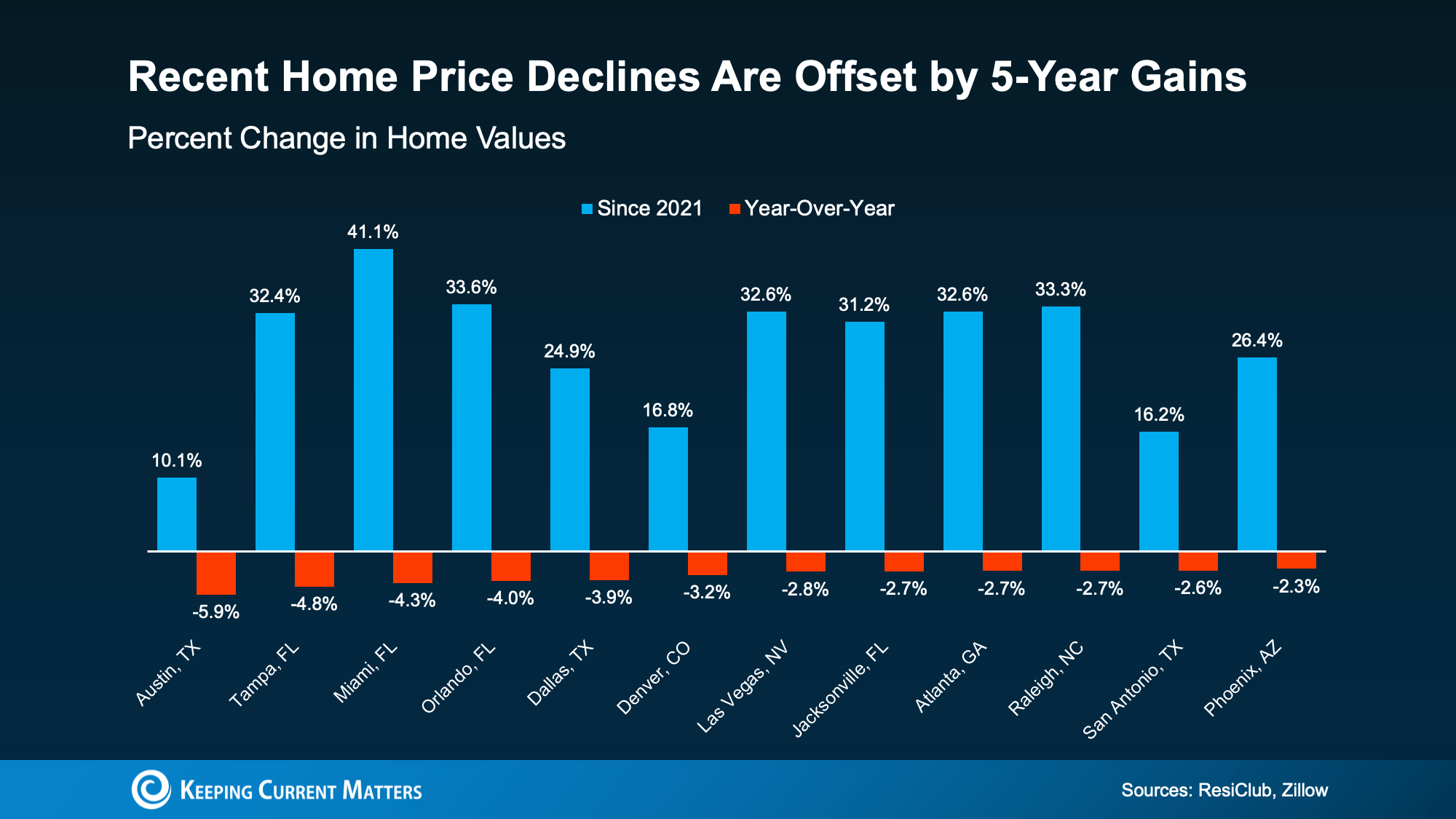 That’s not a crash. That’s just prices moderating after a few record-breaking years.
Online posts are going to make things sound worse than they are. If you want a true, data-bound look at what’s really happening in today’s market, lean on us to assist you with your real estate needs.

If you blew through all eight episodes of BEEF Season 2 in a single sitting, there’s a good chance you spent at least part of that time wondering whether the pristine cliffside country club, the sun-drenched Ojai neighborhoods, and the ultra-modern Malibu mansions were real. Spoiler: most of them are, and some you can actually visit.
Principal photography took place from January to June 2025, with the crew working primarily across Los Angeles and Ventura County before heading to Seoul, South Korea for final scenes. The show’s production designer Grace Yun spent months crafting a visual world that feels like an endless, slightly suffocating vacation, all butter yellows, eternal green lawns, and sun-soaked Spanish architecture.
The fictional Monte Vista Point Country Club is the beating heart of Season 2, a gilded cage dressed up as a paradise. From the very first scene, the show wants you to understand exactly why someone would do almost anything to belong here. The camera sweeps over a cliffside lawn at golden hour, Pacific Ocean shimmering below, guests in linen and cashmere holding cocktails like they were born doing it.
The outdoor athletic facilities, the manicured tennis courts, the championship golf course, and the long fairway views were all filmed at Spanish Hills Club in Camarillo, California, a private country club perched dramatically on the highest point in Camarillo with sweeping views of the Santa Rosa Valley and the Topa Topa mountains. The club sits just minutes from the San Fernando Valley, Conejo Valley, Malibu, and Santa Barbara, which made it a logistically ideal base for the production team.
Lee Sung Jin has been candid about where the Season 2 concept came from. “With the success of Season 1, I had the opportunity to visit a lot of country clubs. It was interesting to see the level of comfort and luxury that is afforded to certain people,” he explained. “As I started to catch myself getting a little bit comfortable, I started thinking maybe there’s something here.”
The club’s Spanish-style architecture, white-washed walls, red clay-tiled roofs, arched walkways gave production designer Grace Yun exactly the kind of aspirational canvas she needed. Her color brief for the entire season was built around the idea of an “endless vacation of lush vibrancy, with eternal green grass and butter yellows,” drawing from the natural topography of the surrounding hills at sunset.
Spanish Hills Club is a private, members-only club, so showing up unannounced won’t get you past the gate. That said, the club does host private events and weddings, so there are ways in if you’re motivated enough.
Also Read: Where Was Roommates Filmed? All the Real Locations Behind the Netflix Comedy
If Spanish Hills provided the sporting grounds, it was the Montecito Club in Santa Barbara that gave Monte Vista Point its soul. The sweeping great lawns, the elegant clubhouse exteriors that appear in nearly every outdoor establishing shot, and that iconic cliffside terrace opening scene, all Montecito.
While Monte Vista is fictional, much of Monte Vista’s outdoor athletic facilities were recreated at Spanish Hills Club’s tennis courts and golf courses, while Montecito provided the space for the lawns and clubhouse exteriors.
The Montecito Club is one of the most storied private clubs on the California coast, located in one of the wealthiest enclaves in the country. It’s a stone’s throw from where Prince Harry and Meghan Markle settled, which tells you everything you need to know about the caliber of wealth the show is riffing on. The club’s gorgeous grounds, draped in mature trees, terraced lawns, and panoramic ocean views made it the perfect physical embodiment of what Sung Jin calls “a perfect microcosm of society.”
Like Spanish Hills, Montecito Club is a private institution, but its exterior and grounds have become recognizable to anyone who has spent time around Santa Barbara. Drive along the coast and you’ll catch glimpses of the same manicured hedges and clay rooflines you’ve been staring at all season.
Also Read: Where Was Balls Up Filmed? See Locations, Cast, and Reviews
One of the smartest location choices in Season 2 is the home belonging to Joshua and Lindsay Martín. The show tells us they live in Ojai – that artsy, spiritual, slightly hippie-adjacent city in Ventura County that has become a refuge for a certain kind of moneyed, wellness-obsessed millennial. But in reality, their half-renovated, warm-toned, English-cottage-meets-rustic-California home is located in Calabasas.

The disconnect is intentional and quietly hilarious. Calabasas is, of course, most famous for being Kardashian country, gated communities, surgical perfection, and the kind of ostentatious wealth that doesn’t try to hide itself. But Josh and Lindsay’s corner of it looks nothing like that. Their home is all exposed beams, earthy textures, and half-finished renovation projects that somehow feel simultaneously aspirational and deeply defeated.
Lee Sung Jin has described the house as a physical metaphor for the marriage itself. The couple has been meaning to finish the remodel for years, just like they’ve been meaning to fix their relationship, and neither is getting done any time soon. Set decorator Kellie Jo Tinney leaned into Lindsay’s “English cottage” aesthetic to show how she uses objects and decor as a substitute for genuine emotional connection: accumulating things because she can’t seem to accumulate the intimacy she actually wants.
The house sits in a neighborhood that gestures toward the organic, laid-back Ojai vibe while being firmly rooted in LA suburban reality, an irony the show wears openly. You can drive through the Calabasas hills and get the general atmosphere, though the specific property is privately owned.
While Ashley and Austin’s apartment interior scenes were shot on a studio set, the exterior establishing shots were captured at a real apartment complex in Newhall, a community within the city of Santa Clarita in northern Los Angeles County.
Newhall isn’t glamorous, it’s a working-class, historically scrappy corner of the LA sprawl that has been slowly gentrifying for years. For a young Gen Z couple who are renters by necessity rather than by choice, it makes complete sense. They’re doing what their generation does: personalizing a space they don’t own, making it feel like theirs through thrift finds and family heirlooms, building something sentimental in a world that doesn’t offer them much permanence.
Production designer Grace Yun described their approach to the space as “sentimental nesting” – driven by objects with personal meaning rather than aesthetic aspiration. There’s no Pinterest board behind this apartment; there’s just two people trying to feel at home somewhere they’re not sure they belong.
Many pivotal sequences for BEEF Season 2 were lensed across Los Angeles, with Radford Studio Center at 4024 Radford Avenue in Studio City serving as the primary production location for interior sets like the apartment, which explains why the exterior and interior feel like they could be two different places, because they are.
One of the season’s most uncomfortable scenes, and this show is not short on uncomfortable scenes, takes place at a lunch Ashley arranges with Eunice (Seoyeon Jang), Chairwoman Park’s interpreter and inner-circle gatekeeper. Ashley is trying to curry favor and establish an alliance; what she gets instead is a masterclass in politeness as social warfare.
The fictional restaurant is called China Bamboo House in the show, but the actual location is Garden Wok, a Chinese restaurant on Ventura Boulevard in Tarzana, in the San Fernando Valley. It’s a real, functional restaurant – nothing like the pristine, expense-account dining spots you’d associate with the country club world, which is precisely why it works so well for this scene. The slightly casual setting undercuts Ashley’s attempts to perform sophistication, which is exactly what the scene needs.
Garden Wok is publicly accessible, which means yes, you can absolutely go eat there. If you find yourself in the San Fernando Valley and want to eat where the beef unfolded, Tarzana is worth the detour.
In a subplot that captures the millennial obsession with pastoral escape and “experiential” luxury, Josh and Lindsay visit a couples’ newly opened resort called Pixie Grove Retreat. They go ostensibly for inspiration, they want to transform their own home into a luxury bed and breakfast, but mostly, if we’re being honest, they go to feel superior. They expect to be unimpressed. They are not.
The sprawling, 100-acre property that leaves them speechless is actually set in the rolling canyon landscape of Agoura Hills, California – a community tucked into the Santa Monica Mountains between Thousand Oaks and Malibu. Agoura Hills has that specific SoCal quality of feeling genuinely wild and remote while being less than 40 miles from downtown Los Angeles. The oak-studded canyons and open grasslands give it a completely different energy from the manicured opulence of the country club scenes, which is exactly the point.
The Pixie Grove Retreat scenes represent the show at its most scenically seductive. The landscape almost steals the scene, which is saying something given that Oscar Isaac and Carey Mulligan are standing in it.
If you want to understand where Chairwoman Park sits in the food chain, look at her house. While the country club drips with old-money aesthetics, warm Spanish architecture, ivy, clay tiles, chandelier-lit dining rooms, her personal California residence is something else entirely: a brutally modern, glass-and-concrete oceanfront structure in Malibu that communicates power without saying a word.
Production designer Grace Yun was specific about the intention behind this choice. Park’s wealth, she explained, is “embedded in the architecture. It’s actually in the texture of the walls and in the flow of the space.” The club is the arena she owns; this house is who she is when no one’s watching, or rather, when everyone is watching on her terms.
The property is privately owned and sits along the Malibu coastline, accessible only by the road that runs along Pacific Coast Highway. You won’t get inside, but you can get close enough to appreciate the architecture and the setting, which, honestly, is half the point of Malibu anyway.
In what might be the season’s most deliciously on-the-nose illustration of how the ultra-wealthy live, Troy (William Fichtner) – a Monte Vista Point member with seemingly limitless resources and a certain cavalier warmth that makes him deeply suspicious – whisks Josh off to Park City, Utah, on a private jet to cheer him up after his dachshund, Burberry, goes missing.
Once in Park City (or so the show tells us), they enjoy a private concert by British electronic band Hot Chip inside Troy’s lavish ski chalet. It’s the kind of gesture so casually extravagant it barely registers as unusual to the people doing it – which is the entire point. The sequence is meant to show how seamlessly the truly wealthy move through the world, treating geography as an inconvenience rather than a barrier.
In reality, neither Josh nor the Hot Chip performance ever left Southern California. The chalet scenes were filmed at a private estate in Thousand Oaks, California, a suburban city in Ventura County that, when dressed up correctly, apparently passes for a Utah mountain retreat. It’s a testament to production design how convincingly the interiors sell the altitude and the exclusivity.
While Josh is off being helicopter’d between states, Lindsay is back in their fictional Ojai neighborhood, doing something far more mundane and far more human: searching for their missing dog on foot, posting flyers on telephone poles, and bumping into people she’d rather not see.
It’s in this setting – Ojai Avenue, specifically the stretch across from Libbey Park, that she runs into Austin and Ashley, also looking for Burberry. The chance meeting softens something between Ashley and Lindsay, and it’s one of the season’s quieter, more genuinely felt moments. The location earns a lot of that emotional credit.
Ojai Avenue is real, publicly accessible, and exactly as charming on camera as it is in person. The Spanish Colonial Revival architecture that runs along the shopping strip the, arched walkways, the low-slung storefronts, the mature trees is authentic Ojai, designated a historic district. Libbey Park, which sits right across the street, is a beloved public green space that hosts concerts, festivals, and the kind of lazy afternoon wandering the show uses to give its characters a moment to breathe.
If you’re visiting the filming locations of BEEF Season 2 in person, Ojai is the most satisfying stop because unlike the private country clubs and gated estates, Ojai Avenue is genuinely open to anyone. Walk the arcade, sit in the park, order something at one of the restaurants that line the street. It feels exactly like the show makes it look.
Troy, it turns out, has more than one impressive property because of course he does. In the Season 2 finale, Josh arrives at Troy’s Southern California home looking for assistance, and the stakes of that visit are matched by the drama of the location.
Location scouts searched through the hills above Malibu and settled on a home on Mulholland Highway, the winding, scenic road that traces the ridge of the Santa Monica Mountains between Calabasas and Malibu. The house exudes the kind of rugged California luxury that is somehow even more intimidating than the clean modernism of Park’s oceanfront property: it’s warm, masculine, impeccably situated, and deeply, quietly loaded.
Mulholland Highway is a public road and one of the great scenic drives in Southern California. While you obviously can’t knock on the door of Troy’s fictional mansion, the drive itself winding through the mountains with views stretching out to the ocean on one side and the Valley on the other, is absolutely worth doing. It’s the kind of road that reminds you why people pay absurd amounts of money to live near it.
The final act of BEEF Season 2 relocates the chaos to South Korea, and the transition is handled with the same visual precision as everything that came before it. When Lindsay, Ashley, Austin, and Ava (Mikaela Hoover) land in Seoul, they check into a hotel for a night of what the show calls in a line that lands like a threat – “heavily surveilled good sleep” before their visit to the mysterious Trochos facility.
Those scenes were filmed at the Conrad Hotel in the Yeongdeungpo District of Seoul, a luxury business hotel that opened in 2013 inside the IFC (International Finance Centre) tower complex on the banks of the Han River. The Conrad Seoul is exactly as sleek and slightly unnerving as the show makes it look.
Standard rooms measure 48 square metres, with unobstructed views of the Han River and the hotel features a signature spiral staircase up to the fifth floor that has been nicknamed “the staircase to heaven.” The hotel’s connection to the premium IFC shopping mall gives it, as one critic noted, a “first-class cosmopolitan feeling” which is precisely the vibe the production was after for this stretch of the season.
Additional portions of BEEF Season 2 were also shot in and around the Amorepacific World Headquarters at 100 Hangang-daero in Seoul’s Yongsan District, during the final phase of the shooting process in June 2025. Director Lee Sung Jin described shooting in Seoul as one of the most memorable parts of the production, particularly working alongside the Korean cast members.
Unlike most of the California locations in the show, the Conrad Hotel Seoul is fully open to the public. Rooms are bookable, the restaurants are open to non-guests, and the lobby alone that soaring spiral staircase included is worth the stop. If you’re planning a Seoul trip and want to do a proper BEEF pilgrimage, this is the one location where you can actually sleep where the cast slept.
Behind every exterior location is a studio, and for BEEF Season 2, that studio was Radford Studio Center at 4024 Radford Avenue in Studio City. The filming venue offers ample office space, green rooms, dressing rooms, multi-purpose rooms, and hair-and-makeup rooms, making it an ideal shooting site for all kinds of projects. Interior scenes, including Ashley and Austin’s apartment, various club interiors, and other controlled environments were built and filmed on the Radford lots.
Radford is one of Hollywood’s busiest independent studio facilities and has hosted dozens of major productions over the decades. It’s not open for public tours, but it sits in the middle of Studio City’s media corridor and has shaped the look of countless shows you’ve seen without ever knowing it.
Netflix’s Emmy-winning anthology series returned on April 16, 2026, with a brand-new story and a cast that somehow makes you want to root for everyone and no one at the same time. Creator and showrunner Lee Sung Jin has swapped out the chaotic road-rage energy of Season 1 for something a little more insidious – a pressure-cooker of class anxiety, quiet ambition, and very expensive bad behavior, all set inside and around an exclusive Southern California country club.
The new season follows four employees at Monte Vista Point Country Club: the newly engaged Ashley Miller (Cailee Spaeny) and Austin Davis (Charles Melton) – young, striving, and a little naive, and the unhappily married Joshua Martín (Oscar Isaac) and Lindsay Crane-Martín (Carey Mulligan), who are slowly losing their grip on everything they’ve built. Hovering above them all is the club’s mysterious new billionaire owner, Chairwoman Park (Youn Yuh-jung), whose arrival sets off a chain reaction of favors, manipulation, and spectacularly bad decisions.
BEEF Season 2 is now streaming on Netflix. All eight episodes are available.
-by

Coldwell Banker - Calabasas
© 2026 Coldwell Banker Real Estate LLC CalRE #01947954 & 01147237
© Coldwell Banker 2023 – 2025. All Rights Reserved. Coldwell Banker and the Coldwell Banker logo are trademarks of Coldwell Banker Real Estate LLC. The Coldwell Banker® System is comprised of company owned offices which are owned by a subsidiary of Anywhere Advisors LLC and franchised offices which are independently owned and operated. The Coldwell Banker System fully supports the principles of the Fair Housing Act and the Equal Opportunity Act.
