

 Facebook
 X
X
 Pinterest
 Copy Link

Local •
April 25, 2026
Seaver College Students “Brand Their Future” at Alumni Career Coaching Event
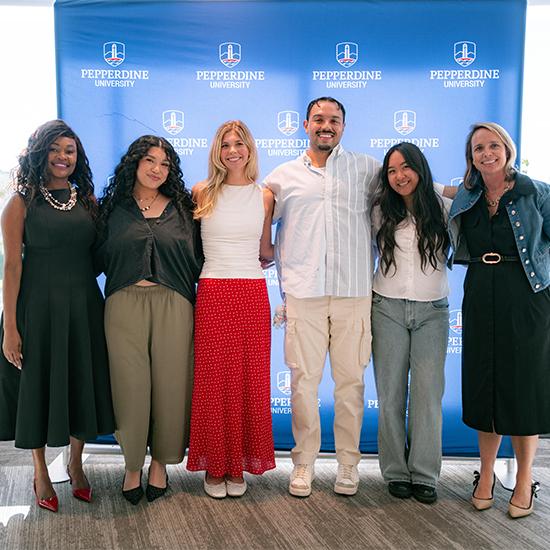
Seaver College’s Communication Division recently hosted its first-ever career day. Students across majors convened at Pepperdine’s Calabasas campus for a special opportunity to network and hear industry insights from a panel of Pepperdine alumni who are successful leaders in marketing, advertising, and public relations.
Alumnus Nils Granger (’10), athlete marketing manager at Red Bull, served as the panelist moderator, hosting the event alongside integrated marketing and communication professor team Sarah Fischbach and Wangari Njathi. Conversation ranged from practical tips for success in a marketing/communication career to panelists recounting the stories of applying to their first jobs.
 L to R: Nils Granger, Nathania Au, Allie Coates, Edwin Duran
Arriving with his wife and three kids, Granger shared that Pepperdine will always be one big family that he is proud to use his expertise to support, especially considering he and his wife met at Seaver and remained college sweethearts throughout.
“There’s a lot of graduating seniors in the room, and I know that the pinnacle of going to college for four years is to get a job,” Granger said to the audience of students. “Don’t worry. Your first job is meant for you to learn and to fine-tune your future; it is only the first chapter of your career. And life has a fascinating way of putting an opportunity in front of you that you would have never imagined.”
For instance, panelist Nathania Au (’24), shopper marketing specialist at beverage company Yerba Madre, told the crowd that she first met Granger as an IMC student. Granger had come to speak to one of her marketing courses, while Au was interviewing for a position at the company he worked for: Red Bull. Considering this serendipity, Au explains that Granger was there to offer helpful guidance as she prepared for her new role postgraduation before joining the Yerba team.
Asked about what advice she’d offer current college students, Au said, “I remember being in the audience at events like this. I was in your shoes. What I would recommend to anyone still in college is to focus less on the quantity of your networking, but the quality. Find the right occasions to have intentional connections.”
 Attendees mingling
“It’s fulfilling to have students reach out and help them get placed in jobs where I used to work or currently work. Now it’s fun to hear their creative ideas and what they’re working on,” added Granger.
Additional panelists included Seaver graduates Jillian Unruh Vincent (’18), associate marketing manager of Mattel’s Barbie Global Brand Team; Edwin Duran (’16), client partner of Snapchat; Andrea Grace Mella (’24), media buyer of Publicis Media, and Allie Coates (’22), brand marketing manager of De La Calle Tepache.
Each of the successful young professionals offered advice on how to stand out among a sea of applicants. Vincent, who now leads brand campaigns for newly released Mattel Barbie dolls, shared that in creative spaces, success is all about “capitalizing on your personal strengths.” She encouraged attendees to think of themselves and what they have to offer in broad terms: “You can take all your experiences and apply them to anything in marketing.”
 Students chatted with panelists
When invited to discuss AI, many of the panelists shared that senior leadership of their corporations have suggested incorporating the technology into their workflow in ways that would not diminish creativity. To help demonstrate this idea, each panelist offered specifics of how they do so.
“I use AI to expedite my understanding of the industry,” Mella chimed in. “I’ll put in example scenarios as a prompt and that will help train me on how to tackle problems that may arise. This helps me to grow in my career.”
Panelists also suggested fine-tuning skills AI is incapable of doing, such as those of public speaking and overall personal presentation, and they reminded students that the hiring process is mutual. While companies are evaluating them, they also have the agency to choose where they want to work. Many suggested writing a list about what they’re most looking for in a company, from job expectancies to desired work culture.
To conclude the event, panelists answered audience questions. Considering such an influx of information might be daunting to a college student on the precipice of the career world, alumni reassured all that they’re beginning in the right spot by attending these networking events.
“All of you are already ahead of the game,” Duran said. “Being in this room is step one. ”
Local •
April 18, 2026
Calabasas AI-Powered Predictive Prevention & Early Detection of Wildfires and Natural Hazards

Greater Mulwood HOA and Mulholland Heights HOA are proud to take a groundbreaking step toward true community wildfire resilience (watch the video). We’ve begun deploying advanced sensors designed to monitor surrounding hillsides and terrain, helping identify risks sooner and slow potential spread. These sensors can assist with both prevention and early detection. They analyze vegetation to identify vulnerabilities, and can detect fires before they become visible to any other camera system and/or someone calling 911. The provider we have partnered with is working with the Santa Monica Mountains Conservancy and is deploying these sensors across the mountains, providing “regional” benefits. Through our partner, we will be collaborating with the UCLA Risk Institute to prepare a data-driven “risk package” for insurance companies.
Our goal is simple: protect our communities while restoring confidence for insurance providers to expand coverage options beyond the California Fair Plan.
Join us in late May for a special event featuring a full presentation of “SensoryAI” technology, along with insights from insurance industry leaders and local authorities. Together, we can build a safer, more resilient future. We encourage you to share this information with your neighbors and friends within the Greater Mulwood area, as your participation is vital in our collective efforts to enhance the safety and quality of our community. Your attendance is highly valued. Please mark your calendars. We look forward to your participation.
Stay tuned for the official date and details.
Local •
April 18, 2026
Calabasas HS “College and Career Night” Draws in Dozens of Colleges

On Thursday, March 26th 2026, multiple college representatives came to the CHS gym to put up booths and promote their schools to Agoura, Oak Park, and Calabasas students. Universities from all across the nation had stands in the gym, including spokesmen from Vanderbilt and Stanford.
At the start, everyone gathered in the gym to tour around different college advertisements and find what’s right for them. Over 40 colleges and universities came to this event. While the majority of the stalls were for institutes, a few were selling summer programs and outside courses. With the developed Performing Arts Program at Calabasas, there was a noticeable population of artistic and musical-focused schools advertising at the College and Career Knowledge Night.
After the first part of the night, participants moved to the PAEC to listen to speeches by the organizer and our superintendent, and later moved around to explore different rooms, each catered to their specific interests.
The two college and career counselors, Nancy Yumkas and Robin Lutsky, at Calabasas, started by introducing themselves and thanking everyone. Following them, Principal Bennett Wutkee, Alan Lazar, and Superintendent Stepenosky took the mics to advise all the students wondering about college.
Mel Johnson from Los Angeles College of Music says they are a “Contemporary program, so people that play instruments, write their songs, record, produce, want to get into music business and production.”
Many of the colleges that attended the night had this trait in common: they are open to a variety of students in their division. Going around the gym, each booth had a diverse variety of students standing in line, and merchandise for anyone who came up to the stands. Pens, fliers, clips, and more were given out.
Besides educational stalls, the US Military also had multiple booths set up in the corner of the gym. Representatives in full uniform were answering questions about the future in place for high school students venturing into the army right after graduation.
The final part of the night had individuals going to different rooms of the school with professionals in their respective fields, based on the students’ interests. One room had a Community College Specialist for those wondering about the College Essay process, and another had an ASU Professor lecturing about fashion in art.
The whole night was aimed at getting students excited and deciding about college.
Calabasas senior Jenna Juridah started the night super interested in the University of Connecticut for Pre-med, as she had been accepted there, she saw the rest of the booths, and she wanted to explore her other acceptances.
Juridah said, “[I] felt more of a drive to go to those schools. So, some of them accepted me, for instance, the University of the Pacific accepted me. I looked at them, and I talked to them, and they were really interesting.”
–,
Local •
April 18, 2026
100 marathons in 100 days : Running with Parkinson’s to Raise Awareness
Larry Grogin refuses to allow Parkinson’s disease to have the last word in his life.
That’s why he has taken on a cross-country trek — much of it on foot — to not only raise awareness for neurological diseases and funds to fight them, but hope for those who live with such diseases that they can accomplish amazing things.
Grogin, a 71-year-old Bloomingdale, New Jersey resident, has begun a quest to run 100 marathons across the United States in 100 days. The project began March 24 and on Friday, the 19th day, he came through Wheeling, with stops in Ohio later as he headed westward. At each stop, he runs and walks the 26.2 miles of a marathon distance.
Grogin, a chiropractor, acupuncturist and herbalist, has been an avid marathoner and triathlete for much of his life. He has more than 300 marathons and 30 Ironman triathlons under his belt.
Yet when he was told by his doctor in 2019 that he had Parkinson’s disease — a neurodegenerative disease that can lead to body tremors, rigidity and slowness — he felt something he hadn’t experienced with his physicality.
“Vulnerability,” he said. “It was the first time that I thought I can’t muscle my way through and beat it.”
Grogin said he had been a muscle-through guy for much of his life, so living with Parkinson’s forced him to go against how he had operated for so long. With Parkinson’s he said, it’s not about conquering the disease, like one would with cancer. It’s about living with the disease.
“You have to learn how to live with it successfully,” he said. “With Parkinson’s, you think about living your best life.”
And at age 71, that best life was conquering an impressive feat for anyone, much less a septuagenarian with a neurodegenerative disease. Yet these runs and walks are something he said is crucial to living with Parkinson’s successfully.
“Movement is medicine,” Grogin said. “It’s such a powerful tool with Parkinson’s and I’ve come to know it personally. Nothing is better for somebody with Parkinson’s, even if it hurts.”
He admits that sometimes it does hurt. He is chronicling the trek on his Instagram page, runlarryrun26, and talks about the bumps and aches that come with running such distances.
He remains undaunted, though. He’s not doing this just for himself, he said. He’s doing it for so many who battle neurological diseases across the United States.
Grogin mentioned that West Virginia, has the third-highest prevalence for Parkinson’s in the United States with around 7,000 cases, and he said that number will only grow.
So he has turned these runs into a fundraiser — Strides For Humanity through the Davis Phinney Foundation for Parkinson’s — and said he has raised nearly $200,000 so far.
He hasn’t been on this path alone. Multiple friends have been and will be with him through the 100 days. His friend Harry Silver was wrapping up his leg of the trip Friday and was meeting a new group in Ohio.
Silver said he marvels at what Grogin has accomplished so far and what he is trying to accomplish with this trip.
“It’s really extraordinary,” Silver said.
“Watching Larry emotionally but also physically through the ups and downs. He powers through the challenge. It’s remarkable, the kind of inner strength you have to have.”
Grogin plans for that strength to carry him across the country to the final destination — Calabasas, California. He said with a chuckle that when he reaches the finish line, he’s going to sit down, close his eyes and not move for a while. He’ll have earned the rest, and he’ll have shown those with neurological diseases that life doesn’t end with a diagnosis.
“It’s about raising funds, raising awareness and raising people’s hope,” he said. “It’s not a death sentence.
“On one of my runs, I was thinking, I’m not dead,” he added. “I may sweat a little bit. I may drool a little bit. I may stumble a little bit. I may even fall a little bit. But I’m not dead.”
Local • Uncategorized •
April 11, 2026
HAPPY BIRTHDAY, CALABASAS!
Spring is in full swing in Calabasas, and there is plenty happening across our community! From celebrating sustainability at the Earth Day Celebration & Green Expo to exploring nature with the WiLD CiTY Spring Series, plus updates on roadway safety, emergency preparedness, and more, this edition has something for everyone. Read on to stay informed, get involved, and see how our community comes together.

HAPPY BIRTHDAY, CALABASAS!
The Calabasas City Council marked the 35th anniversary of Calabasas cityhood during a short ceremony at the Calabasas Civic Center earlier this week. City Councilmembers, City Commissioners, and staff were on hand for the ceremony. There will be other events held throughout the year to commemorate this milestone.
Events and Programs this Month
Earth Day Celebration/Green Expo on Saturday, April 18th
Celebrate sustainability and community at the City of Calabasas Earth Day Celebration & Green Expo on Saturday, April 18th, from 2 to 5 p.m. at Las Virgenes Creek along Agoura Road. This free, family-friendly event brings together local organizations, businesses, and public agencies to share resources, hands-on activities, and practical tips for living more sustainably. See more about our Earth Day Celebration.
The WiLD CiTY Spring Series
Have you heard about the WiLD CiTY Spring Series? This immersive workshop experience connects our community with the remarkable natural landscapes and wildlife found throughout Los Angeles and beyond. This season, the Santa Monica Mountains take center stage, with engaging sessions that invite participants to explore local bird species, experience the landscape through guided movement, and examine the complex relationship between humans and captive animals. Open to ages 13 and up, each workshop also includes an optional opportunity to continue the conversation with instructors at a nearby restaurant, brewery, or tasting room. The Spring 2026 lineup features The Birds of Santa Monica (Saturday, April 18th); Movement in the Mountains (Saturday, May 2nd); and Captive LA (Saturday, May 16th). Learn more about WiLD CiTY and get your tickets here.
City Updates
New Speed Limits
Did you know new speed limits are being implemented across Calabasas as part of a citywide effort to improve roadway safety? Updates will roll out weekly over the next few months. For the first 15 days after each change, law enforcement will focus on education and awareness to help drivers adjust, with standard enforcement beginning afterward. Please watch for new signage and drive safely. Find the complete list of updates and view the Speed Limit map.
Free Health Fair at Calabasas Pharmacy
To celebrate its 30th anniversary, Calabasas Pharmacy is holding a free Health Fair on Saturday, April 11th, from 9 a.m. to 12 noon. Calabasas Pharmacy is located at 22777 Mulholland Highway, in Gelson’s Market.
Family Service Radios PSA
The City’s PSA video below, created in partnership with EPIC, underscores the importance of being prepared to evacuate. Throughout the video, Calabasas residents emphasize a shared takeaway: Access to accurate, timely information is essential during an emergency. To help strengthen neighborhood communication, the City of Calabasas and EPIC are distributing Family Service Radios to residents. These short-range radios (about one to two blocks) allow neighbors to stay connected without interfering with first responder frequencies. In turn, information gathered from residents can be passed along to HAM radio operators in the field and relayed to the Calabasas Emergency Operations Center. Watch the video.
Local •
April 10, 2026
How a One-Hour play is Reshaping Empathy at Calabasas High School

On March 27, the sophomore class attended a performance of Survivors, a one-hour docudrama produced by the Arts For Change organization that brings the Holocaust to life through ten eyewitness accounts by survivors. The production offers students a more immediate personal understanding of one of history’s most devastating events.
Survivors featured the testimonials of Holocaust survivors and how they had to grow up and adapt to the world around them. The performance has become a recurring part of the Calabasas High School curriculum over the past several years. During sophomore year, students typically study the Holocaust in both History and English classes, making the play particularly relevant. Throughout the play, the devastation of the event was felt through the survivors, and how they lost family and friends they made along the way.
The traveling band of actors originated their play at CHS, and have now returned to present for the sophomores. The troop consisted of six actors, and each presented different testimonials.
Adam Weinstein, a history teacher at CHS, believes that seeing the event moves historical knowledge beyond abstract textbooks, bridging the gap between the classroom and real life.
“A lot of times, when you study history, it’s a lot about statistics and numbers. The play helps bring it to life in a way that you might not get in a regular classroom setting.”
Weinstein explained that the play is based on real survivor testimony, allowing students to connect with the material presented.
“It’s actors playing the roles, but it’s based on real-life survivor testimony,” Weinstein said. “The more ways that students can engage with these kinds of things, the better off they’ll be with their understanding.”
By presenting lived experiences, Survivors encourages deeper engagement with difficult topics. Weinstein noted that the production has consistently strengthened students’ comprehension of complex and catastrophic history.
“You’re seeing it in a different perspective than you see in the classroom,” Weinstein said. “This play has certainly contributed toward my students’ understanding of very difficult histories.”
Beyond learning about past events, Weinstein highlighted the purpose of studying history.
“If we’re aware of the past, you can take those things and take steps to hopefully stop it from reoccurring in the present,” Weinstein said. “It’s supposed to also provide encouragement for people to stand up against antisemitism or any other type of discrimination.”
Jade Redfield, a sophomore at CHS, explains why it is important to remember the holocaust and why events like these benefit students.
“They gave a bunch of examples of how history repeats itself, and I think that is true. The genocide of the Holocaust mirrors things that happen today. So I think awareness of the Holocaust and how a lot of people just went with it and were bystanders discourages people from being bystanders in discrimination today.”
The play also demonstrated the many people who helped the Holocaust survivors by allowing them to hide and giving food to Jews. The writer of the play and various actors are descendants of Holocaust survivors, and they drew their inspiration from them.
Organizing the event requires extensive planning and coordination by school admin. Assistant Principal Dr. Katie Booth, who oversees the process, emphasized the importance of setting up logistics.
“We needed to make sure that we have a location and a date that works with all the current productions that are already in place. It’s a lot of coordination about locations and timing, and then meeting with teachers and letting them know.”
Beyond its historical focus, the production connects to broader themes of empathy. By using individual testimonies within a larger moral framework, the production challenges students to not only remember the past, but their own responsibilities in the present.
Booth explained that planning for the event began months in advance.
“The coordination actually started back in August,” Booth said. “One of the first things is finding a space like the PAEC and making sure it works with everything else happening on campus.”
In addition to logistics, Booth shared the importance of the play’s message.
“It is about teaching tolerance and how we can help make a better community by being understanding and kind. So, although it centers around the Holocaust, it also centers around conversations about how we can ensure that we don’t exhibit negative behaviors that have been seen in the past,” said Booth.
Weinstein shared what he hopes his students will learn from the event.
“It’s supposed to also provide encouragement for people to stand up against antisemitism or any other type of discrimination,” said Weinstein.
For educators, the value of studying events like the Holocaust lies in recognizing trends across history. Exposure to these can ensure students have the awareness to break harmful patterns.
“If we’re aware of the past, you can take those things and take steps to hopefully stop it from reoccurring in the present,” said Weinstein.
Part of the goal for students attending is to become aware of injustice and to appreciate all diverse communities.
“We want students to understand how to support others and stand up for people who may be experiencing challenges,” Booth said. “It’s about creating a more supportive and aware community.”
Booth emphasized that the Holocaust remains a critical topic for students to study.
“It’s important that we understand its impact, how that could potentially impact other student groups, and how we can move forward as a community, knowing that we have so many amazing, different groups and individuals on our campus,” said Booth.
Abigail Freeman, a sophomore at CHS, expressed her opinions about the survivors’ play.
“At first, I was thinking, Why would they make this into a play? That sounds really disrespectful, to turn the Holocaust into a play, but I think that they portrayed it really well. They showed the point of view of survivors, and then they also talked about all the different people who died, and I felt that they weren’t going to talk about that. So I’m glad that they mentioned it. I think that it was a good experience,” Freeman said.
Freeman also shared what she hopes students will remember about the performance.
“I hope that they would take away the messages that hate could still happen in the real world today. And to remember the Holocaust, because knowing the past will help us change the future for the better.”
Lastly, Freeman shared why she thinks it’s important to remember the Holocaust and the past.
“There have been stories about how right after the Holocaust, many people didn’t believe that it actually happened. So I think that educating people about it and going to different high schools and telling people a story of the Holocaust is really important,” Freeman said.
The Survivors play encourages students to reflect and apply its lessons to the present. The annual performance remains a tradition that fosters empathy in the Calabasas student body and serves as a reminder of the lasting impact of the Holocaust.
– written and
Housing Market •
April 10, 2026
Thinking About an Adjustable-Rate Mortgage? Here’s What You Need To Know.

If you’ve been looking for a home lately, you’ve probably felt how tough affordability still is. And that’s exactly why more buyers are opting for adjustable-rate mortgages, or ARMs.
Here’s what you need to understand about how they work, and whether they make sense for you.
What Is an Adjustable-Rate Mortgage?
Since a lot of people aren’t familiar with this type of loan, let’s start with a definition. This is how Business Insider explains the main difference between a fixed-rate mortgage and an adjustable-rate mortgage:
“With a fixed-rate mortgage, your interest rate remains the same for the entire time you have the loan. This keeps your monthly payment the same for years . . . adjustable-rate mortgages work differently. You’ll start off with the same rate for a few years, but after that, your rate can change periodically. This means that if average rates have gone up, your mortgage payment will increase. If they’ve gone down, your payment will decrease.”
Basically, one doesn’t change much over the life of your loan.
And one could change… either by a little, or a lot.
Of course, things like taxes or homeowner’s insurance can still have an impact on a fixed-rate loan, but the baseline of your mortgage payment is fairly steady. But the big difference is that with an ARM, your monthly payment could change over time.
Why Adjustable-Rate Mortgages Are Getting More Attention
So, why do some buyers choose this option? It’s simple. It’s because of the upfront savings. Business Insider explains it like this:
“Because ARM rates are typically lower than fixed mortgage rates, they can help buyers find affordability when rates are high. With a lower ARM rate, you can get a smaller monthly payment or afford more house than you could with a fixed-rate loan.”
And right now, according to Mortgage News Daily and the Wall Street Journal, the upfront rate on an ARM is lower than a 30-year fixed mortgage (see graph below):
 If you’re wondering how that shakes out in real dollars and cents, here’s what Redfin says. According to their research, the typical buyer could save about $150 per month by taking out an ARM instead of a 30-year fixed mortgage.
For some people, that’s enough to make a difference.
More Buyers Are Choosing Adjustable-Rate Mortgages Today
A growing number of buyers are willing to trade the uncertainty later for a lower payment now. Data from the Mortgage Bankers Association (MBA) shows the share of buyers choosing ARMs has increased, especially over the last few years (see graph below).
This doesn’t mean ARMs are becoming the go-to option for everyone. It only means some buyers are opting for this type of mortgage, so they can still buy today.
 And if you remember the housing crash, seeing ARMs gain popularity again may raise concerns. But rest easy. Today’s ARMs aren’t the same.
Back then, some buyers were given loans they couldn’t afford once rates adjusted.
Today, lending standards are stricter, and lenders evaluate whether borrowers could still handle the payment if rates rise. So, the return of ARMs doesn’t signal another widespread crash. It just reflects how some buyers are adapting to today’s affordability challenges.
The Trade-Off – What You Need To Consider
If you’re considering an adjustable-rate mortgage yourself, just remember it really all depends on your situation and your risk tolerance.
An ARM may make sense if you plan to move before your rate would adjust or if you expect you’ll make a higher income in the future. But there are trade-offs you need to think through.
For example, once the fixed period ends, your rate can adjust, and your payment could increase, potentially by a meaningful amount depending on where rates are at that time.
And keep in mind, there’s also no guarantee mortgage rates will come down in the future, which means refinancing later isn’t always an option. That’s why it’s important to think through your plan, understand your long-term earning potential, and work closely with a trusted lender before you choose an ARM.
Bottom Line
ARMs are getting more attention again because they can make buying a home more affordable in the short term. But they’re not right for everyone.
The key is understanding how they work, what the risks are, and whether they fit your plan. And that’s why you need to talk to a trusted lender and financial advisor before you make any decisions.
Celebrity Homes •
April 4, 2026
Jean Harlow’s Former L.A. Mansion Can Now Be Yours for $16.8 Million

As the story goes, Jean Harlow was working as a $15-per-day film extra when the eccentric millionaire Howard Hughes cast her as the lead in the sound update of his silent WWI epic Hell’s Angels, where she uttered the memorable phrase, “Would you be shocked if I put on something more comfortable?” That exposure, and a talented press agent who labeled her the “Platinum Blonde,” began a seven-year career that earned her as much as $4,000 a week. Other roles soon followed, including turns in The Public Enemy, Red Dust, Iron Man, The Secret Six, Hold Your Man, Bombshell, and Dinner at Eight.
Unfortunately, she met an untimely death in 1937. Before that, however, the legendary actress—and, arguably, one of the greatest sex symbols of all time—spent her final days at a stately red-brick manor in the Holmby Hills neighborhood of Los Angeles. There, she whiled away her final days amid lavish interiors sporting a hidden Prohibition-era bar, a mink-enhanced bed, and ermine-covered toilet seats; it’s even been reported that she took a dip in the property’s pool every morning.
Designed and built for the star by architect C.B. Clyne in 1932, the estate was last sold in the late 1970s for around $1.1 million to Herman and Marsha Jacobs, who undertook several additions while preserving many of Harlow’s custom touches. Per The Wall Street Journal, the three adult children of the couple, who have since passed away, have now decided to sell the Colonial Revival home, putting it on the market for $16.8 million. David Kramer and Dan Babic of Compass share the listing.
Set beyond gates on a magnolia tree-laced parcel spanning 1.3 acres, the celeb-pedigreed residence offers four bedrooms and seven bathrooms in roughly 7,300 square feet across two levels adorned with boiserie paneling, detailed crown moldings, and marble fireplaces. Standing out is a library with an arched bookcase that opens to reveal a wooden Prohibition-era bar on which visitors have etched their names over the years.
Housing Market •
April 4, 2026
The Hidden Advantage Repeat Buyers Have Right Now

What if you didn’t have a mortgage payment on your next house? It may sound a little unrealistic. But for a number of homeowners, it’s actually doable.
Nearly 3 in 10 homes purchased today are bought in cash, according to the National Association of Realtors (NAR). That’s far more than the pre-pandemic norm (see graph below):
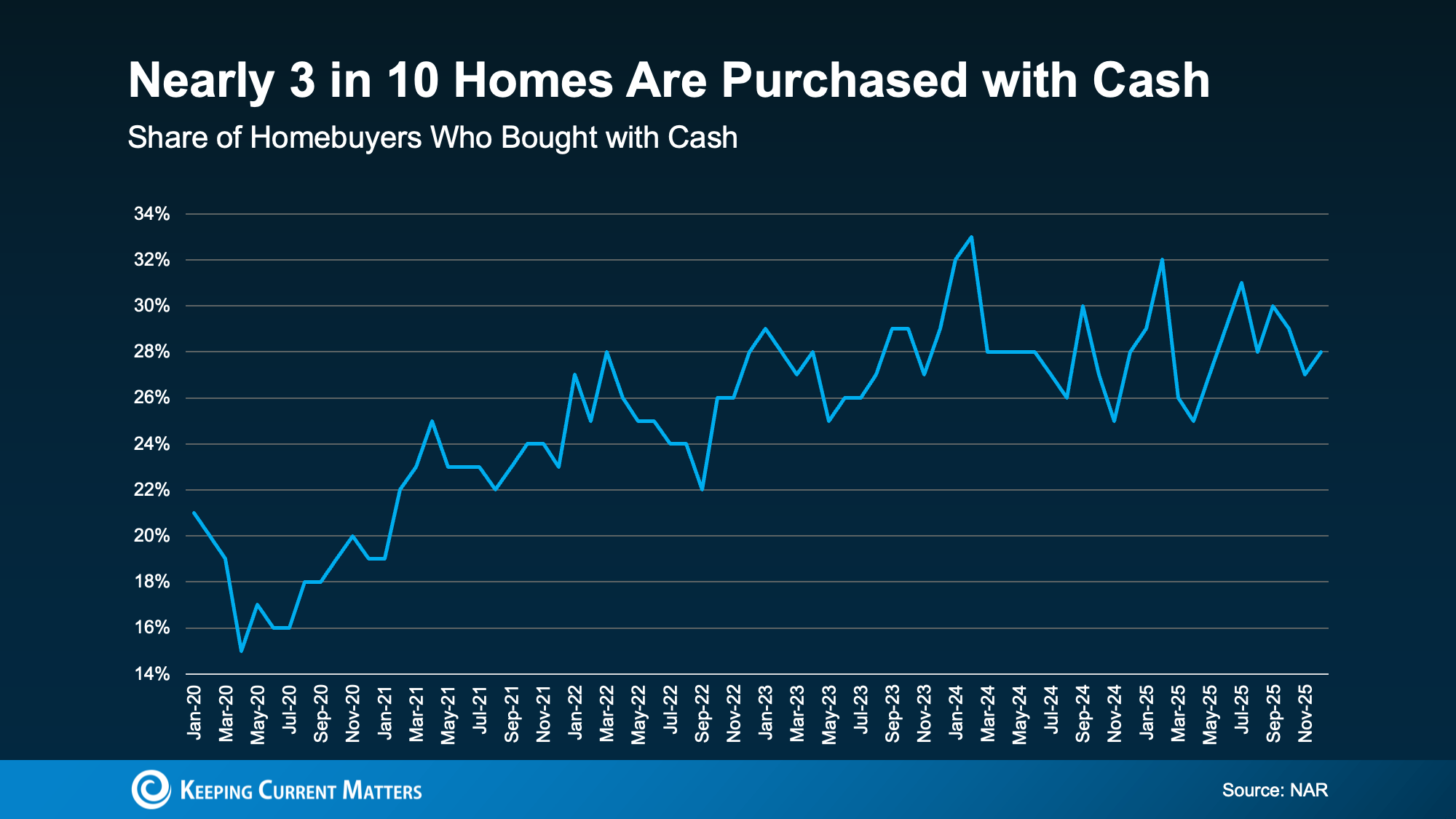 So, how are so many buyers pulling that off? The answer is simple: home equity.
Back in 2020-2021, mortgage rates and the number of homes for sale were both at all-time lows. And that combination pushed home prices up, fast.
If you owned a home during that time, it likely gained significant value – maybe even enough to buy your next house in cash. NAR explains:
“. . . rising home equity has armed many existing homeowners with the financial leverage to make cash offers, allowing them to convert years of price appreciation into immediate purchasing power.”
Here’s why you may want to go that route yourself, if you have enough equity to do it.
1. Your Offer Becomes More Attractive
Sellers value certainty. And an all-cash offer removes one of the biggest unknowns in a transaction: financing. As Rocket Mortgage explains:
“Cash offers are attractive to sellers. Sellers often prefer to work with cash buyers if they can because they don’t have to worry about a buyer’s financing falling through at the last minute.”
In many markets, an all-cash offer can give you a serious edge.
2. You Can Close Faster
And since you don’t have to worry about underwriting, lender approvals, and loan processing, the time it takes to close shrinks. Cotality puts it this way:
“Cash buyers have always enjoyed an edge over borrowers. They remove financing risk, reduce delays, and often close in days rather than weeks.”
If the owner of the house you’re buying is already under contract on their next home or they just need to move fast (like for a new job), that speed is a real draw.
3. You Won’t Have Monthly Mortgage Payments
When you buy in cash, you don’t have to finance your purchase. That means you don’t have to worry about what today’s mortgage rates are and you own the house outright from the day you close. And that’s a big deal.
No mortgage.
No monthly payment.
Full ownership.
That financial freedom opens the door for other big lifestyle benefits. Zillow explains:
“Paying in cash means you own your home outright. This eliminates the need for monthly mortgage payments, freeing up your finances for other priorities like savings, travel, or home improvements.”
4. You May Get a Better Deal
And here’s one more thing that surprises a lot of homeowners: cash buyers often pay less for the house.
According to Cotality, all-cash buyers tend to spend roughly 9% less on the house than buyers who use a mortgage. That’s because some sellers are willing to accept lower offers to get a deal done quickly, with more certainty of closing, and fewer financing hoops to jump through. As Cotality explains:
“From a seller’s point of view, a lower but reliable offer can feel preferable to a higher one that may collapse weeks later.”
And that advantage grows with each passing year (see graph below):
Is an All-Cash Move Realistic for You?
 Is an All-Cash Move Realistic for You?
Not every homeowner will buy their next house outright in cash. And that’s okay.
But the bigger takeaway is this: the equity you’ve built may give you more options than you think.
Whether that means downsizing and eliminating a mortgage entirely, or just relocating with stronger negotiating power, your current house may be what makes it possible.
Bottom Line
Before assuming you’ll need another traditional mortgage, it’s worth asking one simple question: How much equity do you really have? Because the answer might change what you thought your next move could look like.
Curious what your home equity could do for you? Ask us to run the numbers and see what kind of buying power you’re really sitting on.
Housing Market •
April 4, 2026
The Best Week To List Your House Is Just Around the Corner

While the Spring season consistently offers up some of the best conditions for home sellers, Realtor.com says there’s one window where the stars really seem to align year after year. And it’s coming up fast.
Based on their analysis of historical trends, the ideal week to put your house on the market this year is: April 12–18.
And here’s why this window stands out as being particularly seller-friendly:
- Buyers Are More Active. According to the research coming out of Realtor.com, homes listed during this week typically get about 16.7% more views than in a normal week. And in a market where buyers have options, getting that extra attention can set the tone for your entire sale.
- Sales Happen Faster. Realtor.com also explains the added demand from buyers sets you up for a faster process. While homes have been taking longer to sell lately, homes up for sale this week were on the market for 17% less time than usual. And that’s a difference you’ll be able to feel.
- A Better Price for Your House. Since the number of homes for sale has grown, it’s normal for buyers to ask for credits, repairs, and price adjustments today. But, during this early Spring window, about 18.9% fewer homes do a price cut. That gives you a better chance of getting your full asking price.
- More Profit in Your Pocket. According to the study, well-prepped homes listed this week can command a price that’s about $5,300 more than the average week (and $26,000 more than homes at the start of the year).
And what seller doesn’t want more eyes on their house, getting an offer in hand sooner (rather than later), and their best shot at selling for top dollar?
What You Need To Do To Get Ready
If you’re already thinking about selling and you want to take advantage of this sweet spot, your next step is shockingly simple. Just talk to a local agent.
Their expertise on your area is going to be key over the next few weeks. Because these trends are going to vary by state, city, and even neighborhood. And your agent will use that insider knowledge to help you figure out what you need to do now to get your house ready. Including:
- What you’ll want to spruce up before listing
- How to prioritize any repairs (and contractors that can help)
- Quick wins that’ll have a big impact
- What buyers care most about today
For some sellers, that’s a few easy fixes they can knock out in the next couple of weeks. A fresh coat of paint. Some new mulch. Or some light Spring cleaning.
For others, it’s worth taking another month or so to make some minor updates before listing. And that’s okay. Because while this mid-April window may give sellers an advantage, it’s not your only opportunity to sell.
Zillow says the best time to list is in May. And that means the golden window for sellers isn’t closing after this one week. It’s open all season long.
Bottom Line
Getting your house on the market in mid-April may give you an extra edge, but the bigger opportunity is the Spring season as a whole. The real question is:
Do you know what you need to do before you can list?
Because it’s officially go-time for any seller planning a Spring move.
If you want your house to hit the market this week (or even this season), talk to us about what it’ll take to get it ready.

