Facebook
 X
X
 Pinterest
 Copy Link

Housing Market •
September 4, 2026
Sellers Are Cutting Prices To Meet Buyers Where They’re At By Keeping Current Matters

You’re scrolling through listings on your phone and everything looks good until you see the price (or the estimated monthly payment). Then you close the app.
Because even if you love the house, the numbers feel impossible. But here’s the thing.
Nationally, there are more homes sitting on the market than there are people out there looking. And when sellers need buyers more than buyers need sellers, that shows up in the price.
Lower asking prices. More price cuts. And homes priced for what buyers can actually afford – not what sellers hope someone might pay.
And it may be enough to make buying more doable than you’d think.
4 Out of 10 Sellers Are Cutting Their Price
One of the clearest signs sellers are adjusting? Price cuts. HousingWire Data shows more than 40% of sellers are dropping this price.
That’s just slightly behind the volume we saw last year (see graph below):
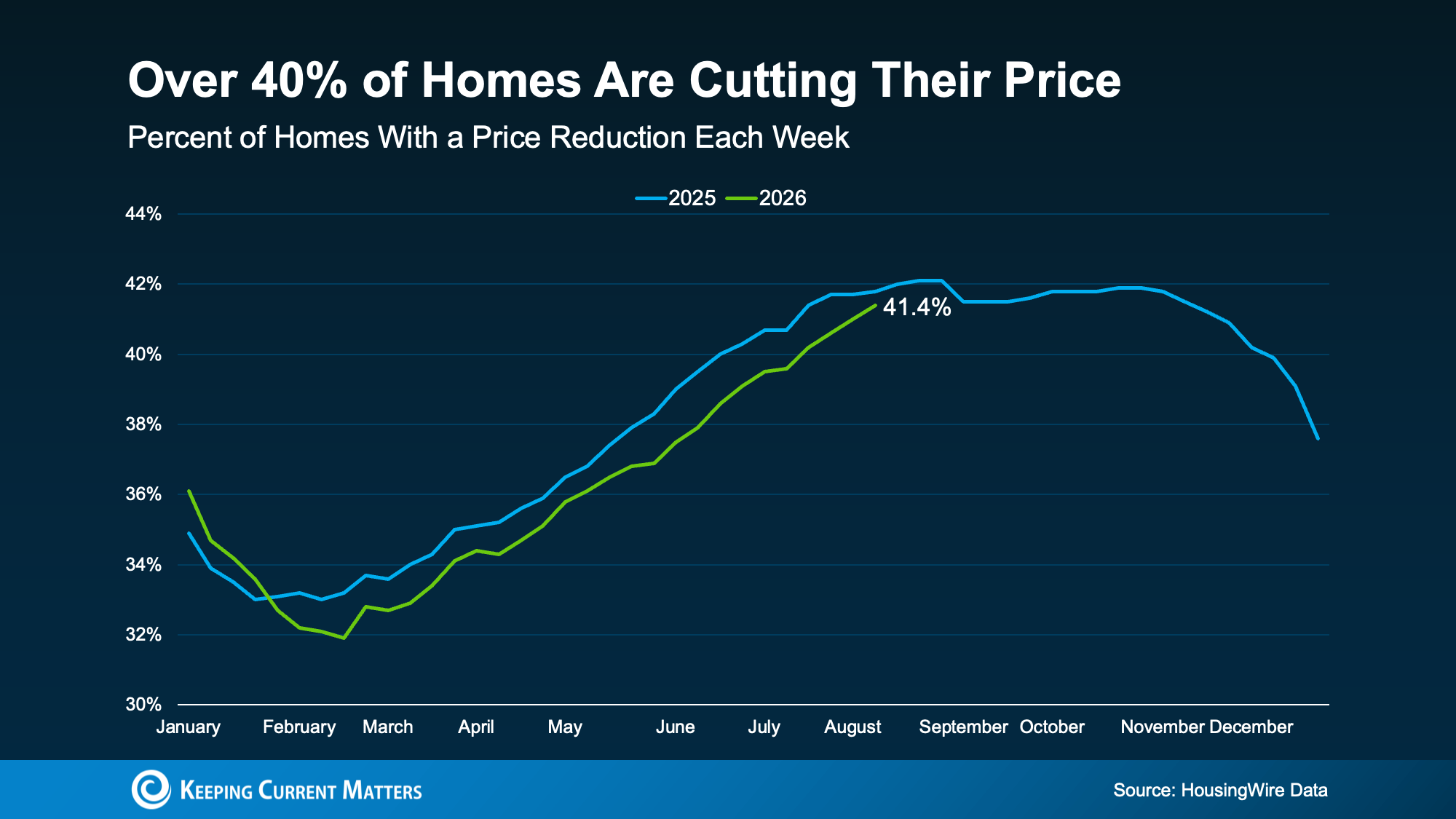
That’s more than 4 out of every 10 homes listed. Think about what that means. That’s thousands of sellers deciding they’d rather lower their asking price than keep waiting for someone willing to stretch their budget.
They know that to sell, they have to be willing to do some give and take. And when no buyers are biting, they’re pulling their biggest lever to draw buyers back in – their price. As Danielle Hale, Chief Economist at Realtor.com, explains:
“This is a market where people are adjusting and showing up rather than giving up. Sellers are meeting the market with more realistic asking prices, which is helping deals get done.”
This July Saw the Lowest Median List Price for Any July in Five Years
What about the other 6 in 10 sellers? A lot of them started with a lower asking price to begin with rather than test the higher price and get crickets from buyers.
That may be why July 2026 had the lowest median list price of any July in the past five years, according to Realtor.com (see the white line in the graph below):
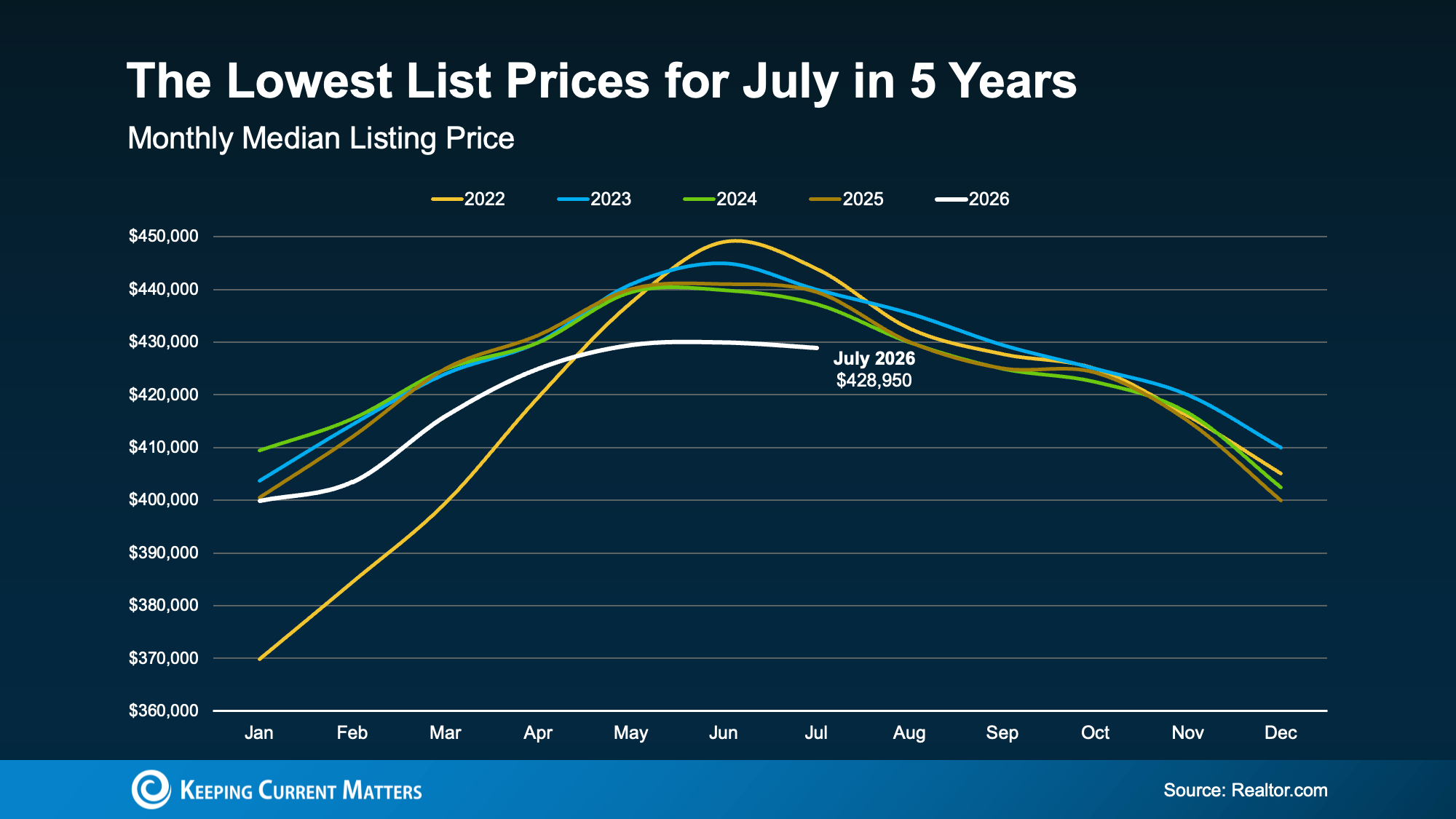
Now, that doesn’t mean home values are falling or that everything’s suddenly a steal. Prices are still above where they were before the pandemic. But what it does mean is this.
Sellers no longer banking on bidding wars or expecting buyers to pay whatever they ask. Instead, many are listing at prices that better reflect today’s market from the very beginning.
And honestly, whether they’re pricing competitively from day one or adjusting after a few weeks on the market, the message for you is the same:
Sellers are more willing to meet you where you’re at.
Because in many markets throughout the country, you’re not fighting over a house anymore. Sellers are fighting over you. And that’s information you can use to get a better deal.
Yes, affordability can be a real challenge. And the monthly payment you take on definitely does matter. But if you’ve been assuming everything is out of budget, there may be more wiggle room than you think.
Bottom Line
Right now, sellers are flexible on the price in ways they weren’t before. Reach out to a local agent to take advantage of that flexibility.
You may be surprised by what’s available – and how willing today’s sellers are to work with buyers.
Food •
August 29, 2026
Tomato Tart – By Taste of Home

Ingredients for Tomato Tart
- Phyllo dough: Phyllo is a special ultra-thin pastry dough that you can find in your grocer’s freezer. Make sure to thaw it in the fridge overnight before working with it, and always keep the unused pieces under a damp towel.
- Tomatoes: You’ll want to use the freshest, ripest tomatoes you can find. If you have access to heirloom tomatoes of different colors, even better, but all red will be just as delicious.
- Bread crumbs: These little texture bombs give an added crunch. Use store-bought or make homemade bread crumbs for a special touch.
Ingredients
- 12 sheets phyllo dough (14×9 inches)
- 2 tablespoons olive oil
- 2 tablespoons dry bread crumbs
- 2 tablespoons prepared pesto
- 3/4 cup crumbled feta cheese, divided
- 1 medium tomato, cut into 1/4-inch slices
- 1 large yellow tomato, cut into 1/4-inch slices
- 1/4 teaspoon pepper
- 5 to 6 fresh basil leaves, thinly sliced
Directions
Step 1: Prepare your phyllo dough

Preheat the oven to 400°F. Set up your phyllo station on a clean counter with a parchment-lined baking sheet and a damp towel that’s been wrung out. Place one sheet of phyllo dough on the baking sheet. Cover the remaining phyllo with the damp towel to keep it from drying out.
Brush the phyllo sheet with 1/2 teaspoon oil, and sprinkle with 1/2 teaspoon bread crumbs. Repeat with all remaining layers of phyllo and breadcrumbs, making sure to brush the oil all the way to the edges.<

Fold each side of the phyllo 3/4 of an inch toward the center, forming a crust with the dough.
Step 2: Arrange the filling

Spread the pesto over the bottom and sprinkle with half of the feta cheese.

Alternately arrange the red and yellow tomato slices over the cheese. Sprinkle with pepper and the remaining feta.
Step 3: Bake the tart

Bake the tart in the middle rack of the oven until the crust is golden brown and crispy, 20 to 25 minutes, rotating once halfway through.
Remove from the oven and cool on a wire rack for five minutes. Remove parchment before cutting. Garnish with basil and enjoy!
How to Store Tomato Tart
Store your leftover tart in the fridge for up to five days. When you’re ready to eat your leftovers, just toast them in a toaster oven or oven until the phyllo has crisped up again.
Can You Freeze Tomato Tart?
You can freeze this tart, but it will always be best when served fresh. Tomatoes hold a lot of water, so freezing and thawing them can be tricky. If you do want to freeze it, freeze before cooking and make sure to wrap it really well in plastic wrap so it doesn’t get freezer-burned. Cook from frozen with a few added minutes.
Tomato Tart Tips

What do you serve with tomato tart?
This tart is versatile enough to be served as an appetizer, side dish or main course. Serve it with a fresh salad or with some roasted vegetables. Or, if you’re serving it as an appetizer, it would go great in a spread with other finger foods like mini meatballs and mini quiche.
What kind of cheese can you use for tomato tart?
So many cheeses would melt wonderfully into a tomato tart. We use feta here, but you could also fontina, Gruyere, fresh or aged mozzarella or heaps of grated Parmesan.
Celebrity Homes •
August 29, 2026
NBA Hall of Famer Kevin Garnett’s Former Ocean-View Malibu Mansion Lists for $48 Million- By Wendy Bowman

After NBA legend Kevin Garnett paid $6.4 million for a prime Malibu property overlooking the Pacific Ocean in 2003, he demolished the existing Mediterranean structure to make way for a custom mega-mansion. The project was never completed under his ownership, and a subsequent $16 million deal to sell the unfinished home to a developer in 2021 fell apart amid fraud allegations and legal disputes.
Resolution arrived in 2022 when Vladimir Valsky, CEO of VIG Private Lending and holder of the senior debt, took control of the site. Opting against a quick sale of the partially built residence, he enlisted celebrated Swiss architect Roger Kurath to complete an extensive transformation focusing on sustainability and fire resilience.
Now completed and christened “Vela,” the ultra-modern home has surfaced on the market for $48 million, with the listing held jointly by Chris Cortazzo of Compass alongside Aaron Kirman and Tomer Fridman of Christie’s International Real Estate Southern California. Spanning nearly seven acres across three parcels—including a developable vacant lot—the sprawling estate boasts grand-scale entertaining spaces and a whole-home generator paired with resort-like grounds hosting an infinity pool, a pickleball court, and a 50-tree avocado orchard.
Set beyond a lengthy gated driveway off Pacific Coast Highway, directly above Escondido Beach, the six-bedroom, eight-bathroom home, clad on the exterior in imported Belgian siding, offers 11,000 square feet across three levels. Open-plan interiors with a European vibe boast a mix of hardwood and stone tile floors, high ceilings, and walls of glass framing sweeping ocean views from nearly every room.

Standing out is a double-height living room with a linear fireplace and collapsible glass doors spilling outside. Beneath a wood-plank ceiling, the kitchen is outfitted with matte black cabinetry, Miele appliances, an integrated wine fridge, a secondary catering kitchen, and a dual-tier island with a prep counter and breakfast bar. Upstairs, the primary suite flaunts a projector, large walk-in closets, and a skylit bath spotlighted by a huge oval soaking tub. Elsewhere is a movie theater, a gym, and a wine cellar, plus a detached yoga studio.
One of the greatest power forwards of all time, the Minnesota Timberwolves legend and NBA Hall of Famer earned around $334 million over his 21-year career and retired with the Timberwolves in 2016. Now primarily based in the Los Angeles area, he operates a production company, Content Cartel Studios, and cohosts the sports podcast, KG Certified with former teammate Paul Pierce. Garnett is also set to have his official No. 21 jersey retired by the Timberwolves in early 2027.
Housing Market •
August 29, 2026
Most Home Sales Close – Here’s How To Keep Yours on Track- By Keeping Current Matters

Few things are as rattling as the thought of your home sale falling through at the last minute, right before closing. All that waiting, all that progress, out the window.
But if you’re getting ready to sell, here’s what you should know. Even in today’s market, it rarely comes to that. Buyers who are moving at today’s rates and prices are generally moving because of some big life change. That means they’re motivated, and eager to get all the way to the closing table.
According to the latest data from Redfin, only about 1 in 7 pending sales are falling through. Meaning the vast majority make it all the way to closing.
And the single biggest thing that puts a deal at risk is the one you have the most power to prevent. It just takes a little smart planning before your house hits the market.
Why Some Deals Fall Apart Before Closing
A Redfin survey sheds light on the most common things that trip up a sale (see visual below):

Here’s a bit more information on each one.
- Inspection or repair issues. This is the big one. When a buyer’s inspector finds a problem, whether with the roof, the plumbing, the foundation, or elsewhere, the buyer can push back, ask you to make repairs, request a credit so they can do it themselves, or see if you’ll lower your price. If they don’t get what they want, they may walk away from the deal altogether.
- The buyer’s financing fell through. Their mortgage loan has to be fully approved in time for closing day. If the loan doesn’t come together, the sale can’t move forward.
- The buyer’s current house didn’t sell. Some buyers need to sell their own home before they can close on yours. If that takes longer than expected, you may run into some issues with your timeline or even see them give up on their move.
- There was a change in buyer’s financial situation. A new job, a big purchase, or new debt can change what a buyer qualifies for on their mortgage loan, even after they were pre-approved.
Where Your Agent Makes the Difference
Some of those reasons are outside your control, like whether a buyer’s loan clears or whether they sell their own home in time. But according to Zillow, there are a few proactive things you can do to help make sure your sale goes as smoothly as possible:
- Save yourself the headache and get a pre-listing inspection. That’s when you get your own inspection before a buyer gets theirs. It lets you find the big issues before a buyer’s inspector does, so you can fix them or disclose them on your terms, instead of scrambling once you’re under contract. In this situation, your agent will help you decide what’s worth addressing and what to just disclose. Handle it now, and the biggest risk to your sale is behind you before a buyer ever brings it up.
- Look at more than just the offer price. Your agent will help you weigh the whole offer, including the buyer’s timeline and any contingencies attached. When a buyer’s offer depends on selling their own home first, the success of your sale rides on a second deal you can’t see. Sometimes, a slightly lower offer with fewer strings is the safer one. Your agent will help you weigh your options and make a plan that works well for you.
One of those is something you can’t do until you have offers in hand, but the other is something you can get ahead of right now. The pre-listing inspection.
That relatively small cost upfront can save you the much bigger hassle of a deal falling apart later. And while getting your own inspection before listing may not make sense in every market, your agent can tell you whether it’s worth it based on your market, your house, and what buyers are prioritizing in your area.
Sometimes the smartest move is staying one step ahead.
Bottom Line
Most home sales still close, and the biggest thing that could get in the way of yours is the one thing you can actually do something about.
With the right prep, your sale has every reason to make it to the finish, and a good local agent can help you get there.
Housing Market •
August 22, 2026
The Kind of House Buyers Are Willing To Pay More For By Keeping Current Matters

That spare room on the main floor. The finished basement with a kitchenette and its own entrance. The bonus room you’ve been using for storage.
To you, it’s extra space. But to a growing pool of buyers, it’s the reason they’d pick your house. Here’s why. Multi-generational homebuying is on the rise.
Millions of Families Are Living Multi-Generationally
The number of multi-generational households is climbing. That’s when 3 or more generations live under one roof. And data shows those households grew from 3.2 million to almost 4 million between 2014 and 2024, according to Realtor.com.
And each year, more people are shopping for a larger home that fits their combined needs.
While the appetite for this type of house is rising across the board, data from USAFacts shows multi-generational living is more common in some states than others. The darker the state in the map below, the more common it is in that area (see map below):

Where does your state fall? Depending on where you are, the pool of buyers looking for a house like yours could be even bigger than you’d think. But the overall bottom line is this.
There’s a real market out there for larger homes with room for multiple generations under one roof, especially since affordability is still so tight. And if you own a house like that, it’s in demand.
Multi-Generational Houses Sell at a Premium
And that extra room carries real value with the right buyer. According to Realtor.com, in 2025 the median asking price for a multi-generational house was $709,000 – roughly 65% higher than the $429,900 median for a standard house.
Some of that is simply size. But compare multi-generational homes to regular homes with the same amount of square footage, and they still come out on top – $262 per square foot versus $215.
That’s a 22% premium you could command for special features like in-law suites, second kitchens, and separate entries (see graph below):

When you sell, this could help you walk away with more money in your pocket, especially when your agent highlights your home’s multi-generational-friendly features in your listing.
And Buyers Aren’t Getting Sticker Shock
And even with slightly higher price tags, buyers aren’t flinching. Multi-generational houses drew 13.5% more online views than standard ones, and they still sold just as fast – in about 59 days – per the same Realtor.com report.
Hannah Jones, Senior Economic Research Analyst at Realtor.com, explains:
“The strong demand and steep premiums we are seeing in inventory-constrained markets point to a real mismatch between what buyers are looking for and what is actually available. For sellers in these markets, this type of home can be a significant asset.”
Basically, when buyers want something that’s very specific, the house that checks the box tends to stand out.
Bottom Line
Your multi-generational-friendly, or simply larger-than-average, house might meet criteria a lot of buyers can’t find in a standard one. That’s what gets attention. And offers. So, talk to a local real estate agent about what it could get you in your market right now.
Celebrity Homes •
August 16, 2026
Weezer’s Scott Shriner Lists His Los Angeles Home for $3 Million By Wendy Bowman

After eight years of ownership, Scott Shriner and his soon-to-be ex-wife, author Jillian Lauren, are parting ways with their midcentury home in the eclectic neighborhood of Eagle Rock, in the far northeastern reaches of Los Angeles. The sale comes amid the couple’s decision to end their marriage after two decades.
The longest-running bassist of the Grammy-winning rock group Weezer—known for hit songs like Say It Ain’t So, Buddy Holly, and Undone (The Sweater Song)—is asking just under $3 million for the hillside spread, which he and Lauren acquired in 2018 for roughly $1.8 million. Linda Chamberlain of Nourmand & Associates represents the listing.

Built in the early 1950s, the cream stucco and taupe-trimmed structure has five bedrooms and four bathrooms in a little more than 3,000 square feet showcasing rustic oak flooring beneath vaulted wood-beam ceilings. Outdoors, the woodsy grounds span almost half an acre and include a heated pool flanked by a spillover spa covered in blue mosaic tiles, plus a long gated driveway leading to a detached two-car garage.
Highlights include a sprawling, light-filled living and dining area anchored by a towering fireplace. An updated eat-in kitchen has quartz countertops and collapsible doors opening to an entertaining deck, while the primary bedroom comes with an en suite travertine bath. There’s also a separate space that served as Shriner’s professional music studio that could easily be converted into a guest suite or an office.

The property gained national attention after a highly publicized backyard standoff last year between LAPD officers and Lauren. The incident—which stemmed from a neighborhood hit-and-run chase that she was not involved in—resulted in gunfire and a grazing wound to the author, leading to charges that were later resolved through a mental-health diversion program, according to Rolling Stone.
Regardless of the turmoil, Lauren related in a press statement that the property has still been an incredibly special place to live. “What I’ve loved most about this home is the sense of peace and privacy it provides,” she said. “Once you’re behind the gates and surrounded by the trees, it truly feels like your own personal retreat.”
Food •
August 16, 2026
The Best Detox Crockpot Lentil Soup By Pinch Of Yum

Ingredients You’ll Need
This soup is jam-packed with so many wholesome, feel-good ingredients. Let’s count them up, shall we?
- butternut squash
- carrots, celery, and onion (or mirepoix)
- potatoes
- green lentils and yellow split peas (you can use more green lentils if you can’t find split peas)
- garlic
- broth
- herbs de provence
- kale and fresh parsley
- a swish of olive oil and red wine vinegar at the end
How To Make This Lentil Soup Recipe
As is my goal with most recipes I make for Pinch of Yum, this crockpot lentil soup was made for real life. Because it’s literally for my real life. This is a fall life-saver.
- Start With Flavor: We’re starting with a solid base: onions, garlic, carrots, celery, spices, salt, and broth.
- Add The Vegetables and Lentils: Then we’re getting awesome by adding butternut squash, which partially melts into a creamy textured miracle, lentils (always lentils), and yellow split peas because WOW color.
- Puree and Serve: After all your feel-good vegetables simmer up into the best house smells and then we do the magic thing that takes it over the top: puree a portion of the soup with that olive oil to form a silky emulsion that then gets added back into the soup. YES PLZ 4EVR.
I ended mine with a splash of sherry and red wine vinegar because I’m currently having a moment with tangy foods.


What To Serve with Lentil Soup
There’s a lot going on in this soup, but if you want to round it out with more in the meal, I’d recommend a few extras:
- No Knead Bread (YES)
- No Knead Cheese Bread (DOUBLE YES)
- House Favorite Garlic Bread (TRIPLE YES)
- One-Ingredient Socca (yummy gluten-free flatbread for dipping purposes)
- A simple green salad (like this one!)

That’s it. That’s the soup. SO EASY. It requires a bit of front-end chopping to prep the veggies, but I’d guess it took me 30-45 minutes to cut everything up and get it in the crockpot, and in return I was gifted with 8 soup servings of this nutritious + cozy wonderfood. NOT A BAD DEAL.
Cheers to you and your people enjoying many glowing bowls of crockpot lentil soup for all the days to come. 👍👍👍
Housing Market •
August 15, 2026
Big Investors Are Backing Off and That’s Your Opening By Keeping Current Matters

For years, a lot of would-be homebuyers have worried about the same thing. How do you compete with big investors who can swoop in, pay cash, and snap up the houses you want?
Well, worry a little less. Because right now, those big investors aren’t buying up the market. They’re backing out of it.
Investors Are Buying Fewer Homes Than They Have in Years
According to Redfin, investor home purchases just fell to their lowest level since 2020 – when the start of the pandemic temporarily caused pretty much all homebuying to pull way back. Before that, you’d have to go all the way back to 2016 to find a time when investors bought this few homes (see graph below):
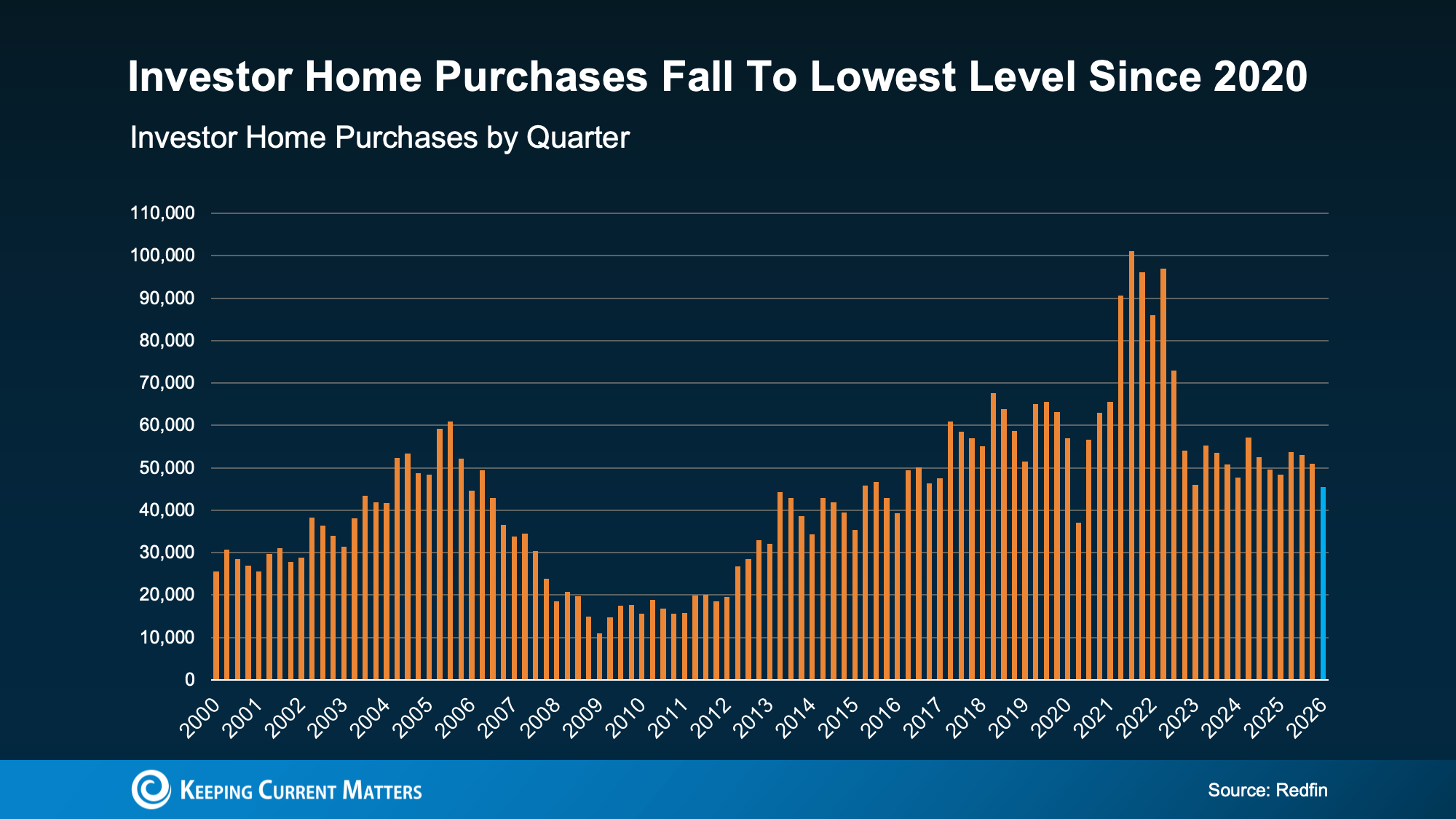
Why the step back? Two big reasons.
First, Washington passed a housing law that takes aim at large institutional investors. To be clear, these mega investors were never as big a part of the market as the headlines made it sound. They’ve always made up a relatively small slice of housing pie. But the law still targeted the largest ones, and it worked fast. According to Thom Malone, Principal Economist at Cotality:
“When Washington announced its intention to curb institutional investors’ homebuying, the market reacted. . . Cotality data shows that investment by mega investors who own 1,000 or more properties retracted almost instantly.”
Second, the housing market has cooled. Price growth has slowed in much of the country, and in some markets, prices are dipping. That makes the math a lot less appealing for investors betting on quick gains. Lance Lambert, CEO of ResiClub, explains:
“Ever since rates spiked and the Pandemic Housing Boom fizzled out in spring 2022, institutional single-family rental (SFR) operators have pulled way back from buying up homes on the resale market—the math just isn’t as appealing right now. Home prices and rents are no longer ripping, holding costs (property taxes and insurance) have jumped, capital markets have shifted their attention elsewhere, and elevated materials prices make renovations expensive.”
They’re Not Just Buying Less – They’re Selling More
This is the part most people miss. Big investors aren’t just slowing down their purchases. Data from Parcl Labs and ResiClub shows the largest institutional investors are now selling more homes than they’re buying – and that gap is growing these past 4 quarters (see graph below):
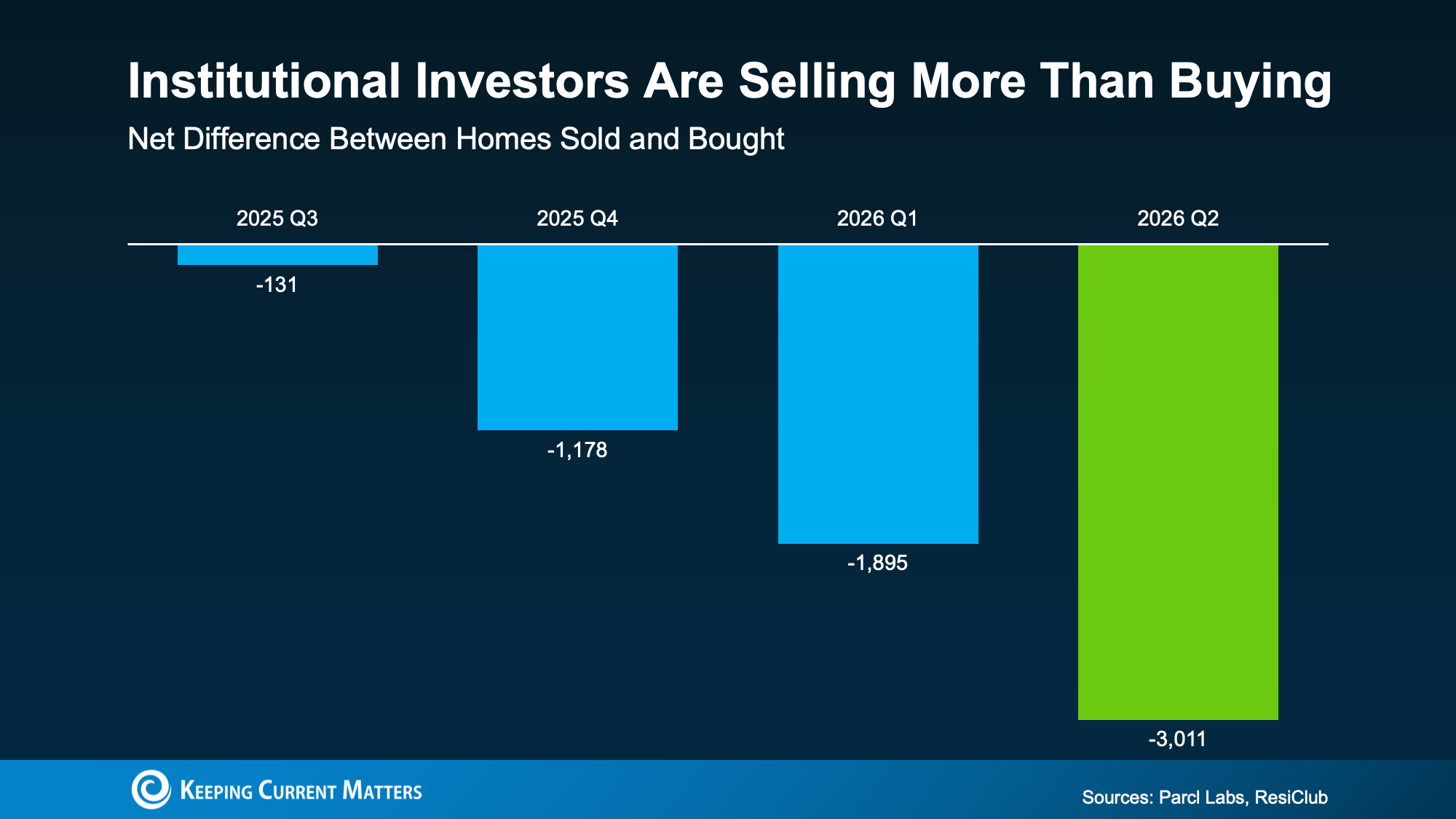
Every one of those homes goes right back into the market for buyers like you. And since big investors tend to own homes at the lower end of the price range, a lot of what they’re selling is exactly the kind of home first-time buyers are looking for. As Malone puts it:
“. . . this sudden dropoff in institutional investment is a signal to first-time homebuyers that there’s an opening.”
Less competition from deep-pocketed buyers. More homes hitting the market. And many of them at prices that work for a first purchase. That’s a shift that works in your favor.
Bottom Line
Big investors are stepping back, and they’re adding homes to the market as they go. If you’ve been waiting for a better shot at buying, this could be it. Connect with a local agent to find out what’s popping up in your area. You may have more options than you think.
Celebrity Homes •
August 15, 2026
Elizabeth Taylor’s Bel Air Estate to be Preserved in $47 Million Makeover By Architectural Digest

Contrary to earlier reports, it appears that Elizabeth Taylor’s famed two-story ranch-style home at 700 Nimes Road in Bel Air will not be demolished. The 7,000-square-foot residence, where the star lived from 1981 until her death in 2011, will remain intact—though it’s getting a facelift. Per the New York Post, the estate’s 1.3 acres will undergo a $47 million makeover. Current owner and mega-mansion developer Ardie Tavangarian’s plans for the property include a massive 12,000-square-foot subterranean and above-ground buildout.
Tavangarian—whose contemporary, amenity-rich spec homes often fetch upward of $100 million—told the outlet that the original home will essentially serve as the “Elizabeth Taylor wing” of the revamped pad. Rooms dear to the Cleopatra actor, like her primary suite, her beauty center—which included a shampoo station—and the room that held her storied precious gems will receive a makeover, while the rest of the house will be refashioned to transition into a new build.
“We’re just modernizing it from a point of view of functionality,” Tavangarian told the Post. The designer also plans to install a gallery in the original home, outfitted with Taylor-related art. The icon’s sapphire-colored swimming pool, koi pond, and rose garden will also remain much as she left it upon her death in 2011.
The above-ground addition will bump the ranch up to two stories and in some places, three. Tavangarian tells the Post that he is “approaching this as though she is my client,” building out the interiors of the three-bedroom addition with amenities he believes the late Taylor, known for her glamor, would have loved. Highlights of the plans include a state-of-the-art screening room, a “pajama room” for lounging, a 4,500-square-foot retractable roof for stargazing, and a spa. Not all of the additions will strive for modernity; Tavangarian plans to carry over the original home’s exterior exposed brick facade to the new structure in order to maintain visual cohesion.
Taylor moved into 700 Nimes Road right after Nancy Sinatra’s residency. Sinatra, the first wife of Frank Sinatra, sold what was originally a one-story bungalow to a developer, from whom Taylor purchased the home.
The Cat on a Hot Tin Roof star was known for making her space cozy and homey—a far cry from the blinged out persona she portrayed for the cameras. Taylor invited AD into her sanctuary a few weeks before she passed away 15 years ago, and photos from that feature reveal warm and inviting spaces with lots of color, portraits, and flowers. At the time, a personal assistant to Taylor told AD that “she lived with paintings by Pissarro, Degas, and Renoir, but wanted people to feel comfortable enough to spill a drink and not freak out.”
Food •
August 15, 2026
Roasted Red Pepper Pasta By Pinch of Yum

Restaurant-level pasta, easy enough to be SOS! Caramelized shallots folded into a silky red pepper sauce, and tossed with noodles. Heaven!
INGREDIENTS
Roasted Red Pepper Pasta:
- 1/2 cup roasted red peppers (jarred, drained – 3-5 pieces)
- 3/4 cup water
- 1/2 teaspoon Better than Bouillon chicken or vegetable broth base
- 2 tablespoons butter
- 1 large shallot, sliced thinly on a mandoline
- 3/4 cup heavy cream
- 8 ounces pasta – my favorite is pennoni
- 1/2 cup reserved pasta water (optional, as needed)
Toppings:
- 1/4 cup Parmesan
- basil leaves and/or red pepper flakes
INSTRUCTIONS
- Red Pepper Puree: Blend the red peppers, water, and broth base until smooth.

- Saute the Shallots: Heat a large skillet over medium heat. Add the butter and shallots; sauté until the shallots are lightly golden brown and caramelized, about 10-15 minutes.
- Cook Pasta: During this time, cook the pasta according to package directions, to al dente so the noodles can finish in the sauce.
- Combine Sauce: Turn the heat down to avoid splatters; add the red pepper puree and let it sizzle out for a moment. Then add the cream. Stir to combine; let it gently bubble for a few moments until it has thickened into a nice creamy sauce.
- Add Pasta: Add pasta into the sauce; let it simmer for a few moments to thicken and coat the noodles. If needed, add reserved pasta water to reach desired consistency.
- Yum. Serve immediately, topped with Parmesan, basil, and/or red pepper flakes. It’s so gooood.