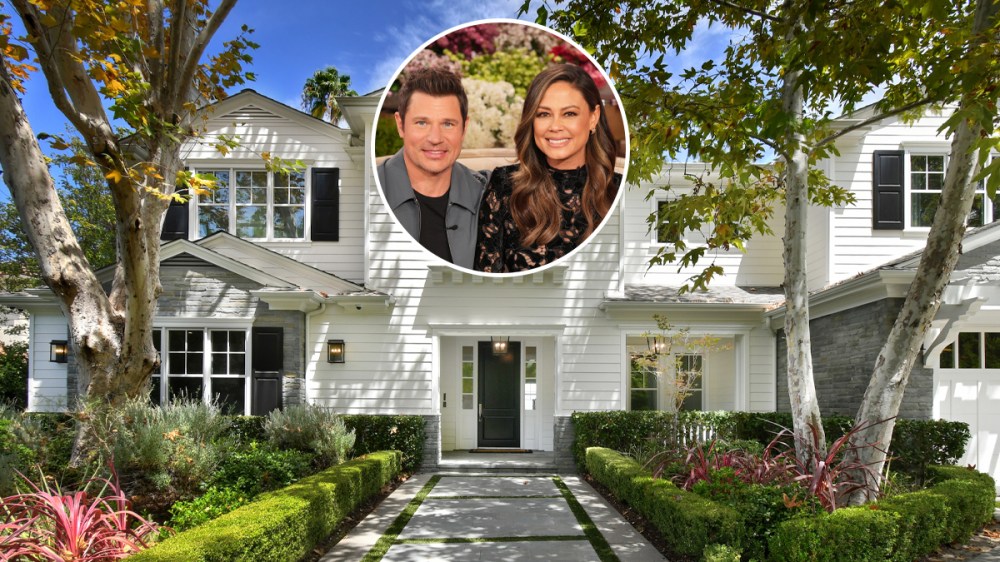
Nick and Vanessa Lachey put their Encino home up for sale a little more than a year ago and doled out $8 million to buy back another property in nearby Tarzana they had owned and sold once before. Now, as they plan to leave California for a new chapter, the pair is looking to offload the sprawling San Fernando Valley mansion with a $245,000 jump in price.
The married reality TV show hosts have put an $8.195 million price tag on the East Coast traditional-style residence they picked up from tennis superstar Naomi Osaka in August 2025 for $7.95 million. Before that, it was owned by former NFL wide receiver Randall Cobb, who sold it to the Lacheys in 2020 for a dash over $5 million. Built in 2014 and renovated and expanded by Osaka, the home is listed with Mauricio Umansky and Craig Knizek of The Agency.
A coffered-ceiling family room opens to a covered loggia via pocketing doors.James Moss
Set beyond a cul-de-sac and a double-gated driveway on a flat lot spanning over half an acre, the white horizontal lap-sided and black-shuttered house offers a total of six bedrooms, six full bathrooms, and two powder rooms. Roughly 7,000 square feet across two levels showcases engineered hardwood floors paired with walls of glass overlooking picturesque valley and mountain views.
A walkway framed by mature trees and boxwood hedges leads up to a columned porch. Inside, a coffer-ceilinged family room sporting a fireplace and built-in bookshelves spills out to a covered loggia, while a kitchen with dual islands adjoins a breakfast nook. Other highlights include a formal dining room embellished with wainscoting, a movie theater, a game room with a wet bar, and a wine cellar, plus a second-floor primary suite flaunting two private balconies.
Osaka added a guesthouse/gym that includes neon inspirational quotes.James Moss
In addition to an 800-square-foot detached guesthouse/gym with a kitchenette and bath added by Osaka, the backyard hosts a pool with a Baja shelf and an inset spa, a barbecue station, a fire pit, and a sunken sports court. Out front, a four-car garage anchors a motor court with parking for up to 20 vehicles.
The Encino property that the Love Is Blind co-hosts purchased in 2024 for $6.8 million recently sold for $6.15 million, after first listing for $7.5 million. The couple previously owned a Hawaii home near Oahu’s Kahala Beach they bought in 2022 for $8.8 million, shortly after Vanessa was cast in the CBS show NCIS: Hawaiʻi. They sold that house two summers ago for nearly $9.5 million after the police procedural was canceled.
Most sellers come into the market with one number in mind. And it’s often the one that costs them the most. That’s their asking price.
A survey from Realtor.com shows about 8 in 10 (80%) of sellers expect to sell at or above their asking price today. But here’s where things get interesting.
In reality, only about 4 out of every 10 (roughly 40%) actually do.
That’s a big gap. And it’s where a lot of sellers get caught off guard. So, why the disconnect? And how can you set yourself up to be one of the 4 in 10 that get top dollar?
Let’s break it down.
What Should You Really Expect To Get for Your House?
That 40% may sound low at first, but it’s not.
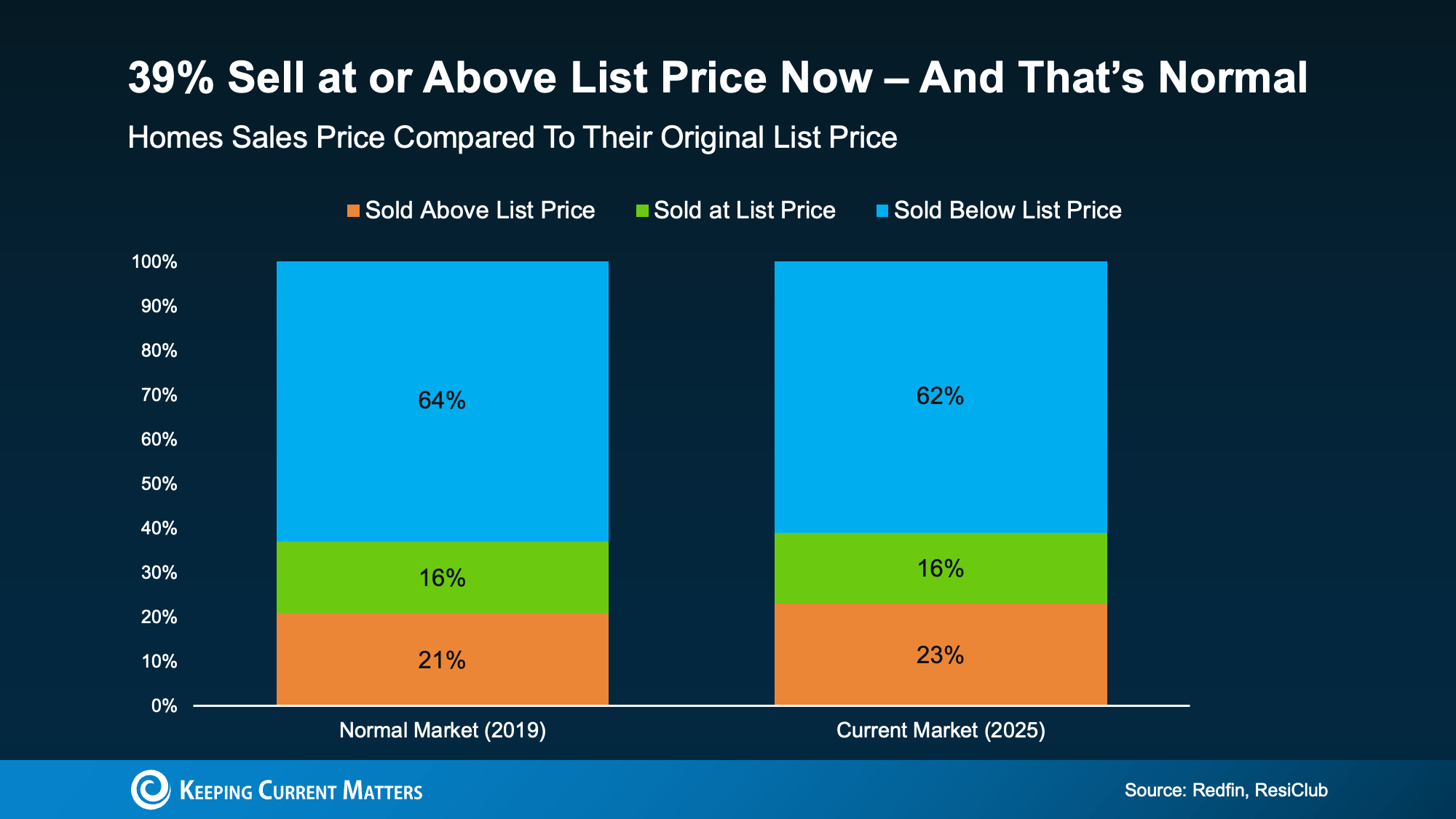
If you look back to the last typical year for the housing market (2019), what we’re really seeing is a return to what’s normal (see chart below). If anything, slightly more homeowners are able to sell above list price today compared to 2019:
It only feels low because the past few years were anything but typical. Between 2020 and mid-2022, buyer demand was sky-high and the number of homes for sale was at record lows. Almost everything sold over asking.
Now, the market has shifted.
There are more homes for sale. Buyers have more options. And that means they’re more selective about how they spend their money.
In other words, the rules have changed – and pricing like it’s still 2021 is where sellers run into trouble. You have to meet the market where it is if you really want to cash in big.
What Happens When a Home Is Priced Too High
Here’s the reality. It’s easy to think pricing high gives you room to negotiate. But it usually does the opposite.
When your home is priced above what buyers expect, in this market, they don’t negotiate. They move on.
Because buyers notice price first. And if your home doesn’t line up with similar options in your area, it may not even get a showing. And that’s when things start to snowball:
A high price gets less interest from buyers.
Less interest means fewer offers.
And fewer offers usually means more time on the market.
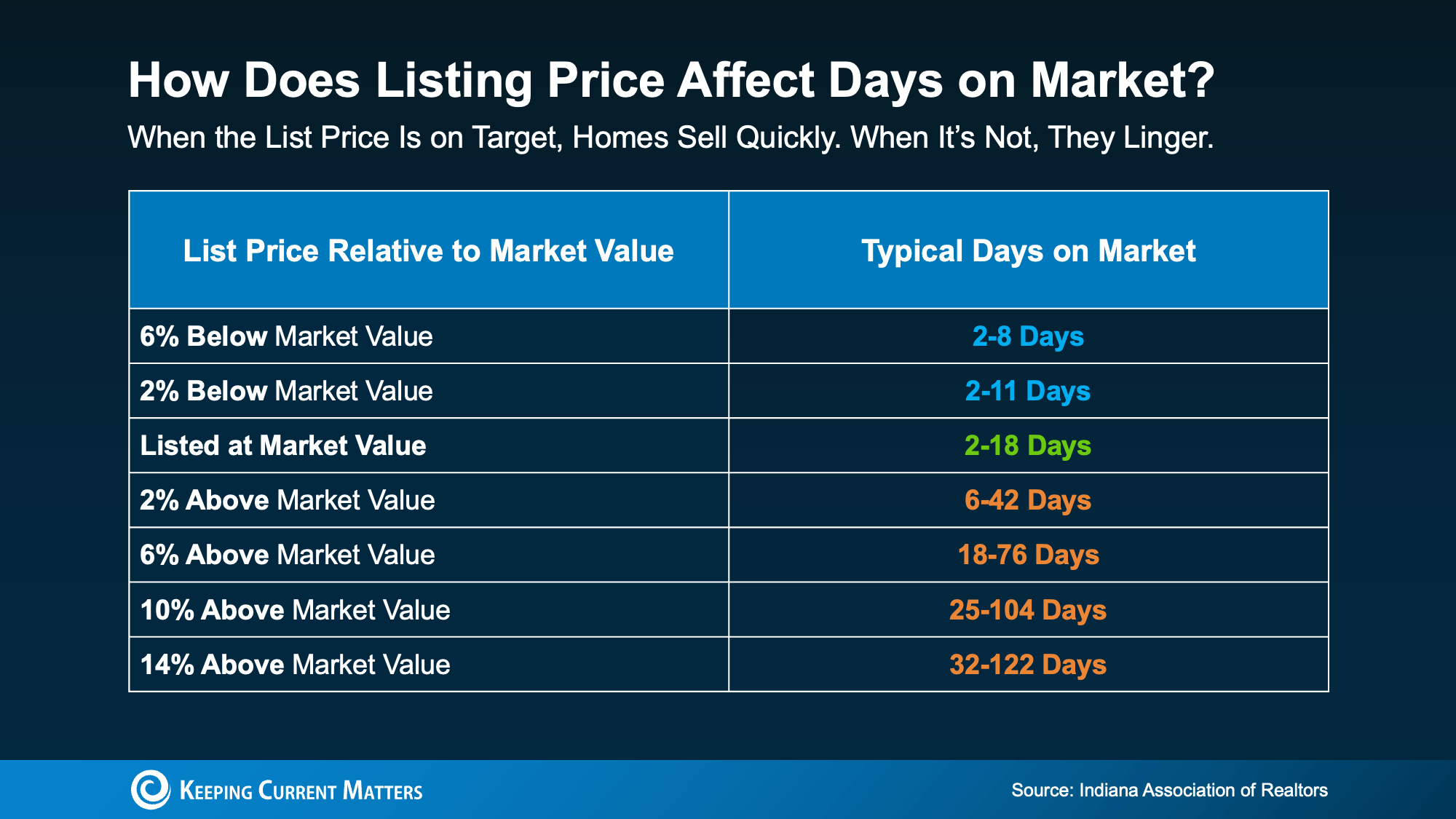
Take a look at this table from the Indiana Association of Realtors. While this data is from one state, the general trend is going to hold true across many markets in the country. It shows that homes listed at or under market value sell fast. But homes priced high? They linger. And that delay comes at a very real cost.
The Price Cut Trap (And How To Avoid It)
When a home sits that long without offers, a lot of sellers will do a price reduction. According to HousingWire Data, over 40% of sellers are going that route today.
But here’s the real problem. Even a price cut doesn’t guarantee a sale.
In fact, some buyers will see a reduction as a sign something’s wrong with the house – even when nothing is.
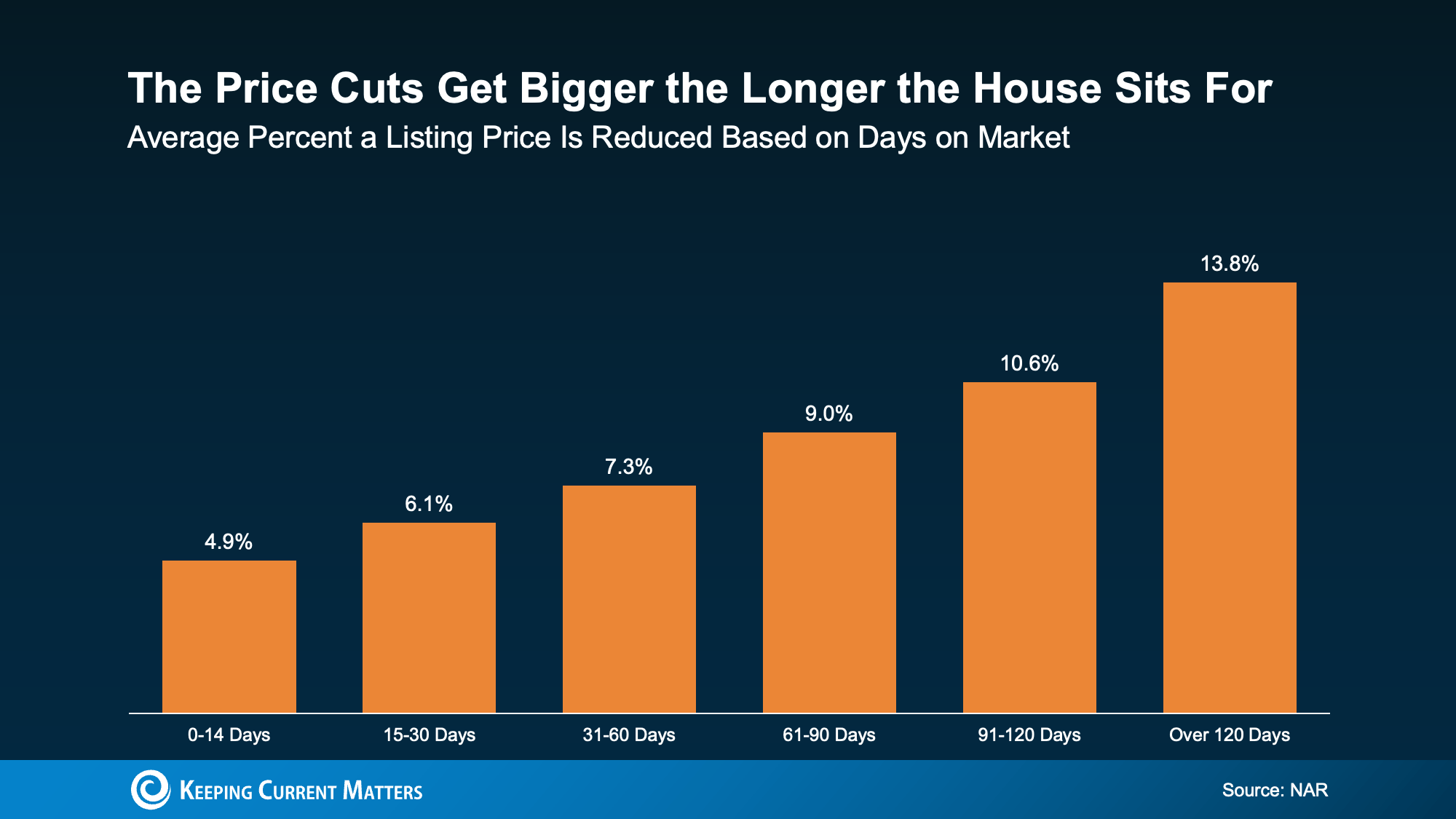
That’s why data from the National Association of Realtors (NAR) shows the longer a home sits, the bigger that price cut tends to be to attract buyers back:
So, what starts as a strategy to “leave room” for negotiate can end up costing you more in the long run.
Why Pricing Right from Day One Matters
Even though listing at or even just shy of market value may sound counter intuitive if you’re looking to get as much money for your house as possible, a lot of the time it really is the best strategy.
Because the goal isn’t just to list your house to see what price sticks. It’s to price it in a way that creates demand from day one.
“While some sellers are pricing their homes higher than ever, a more ‘goldilocks’ frame of mind is a better approach to avoid price cuts and lingering time on the market.”
In other words, there’s a sweet spot. Too high, and buyers disappear. Too low, and they question the value.
But right in the middle? That’s where the magic happens.
And that’s where the right agent comes in.
They help you understand what buyers are actually paying right now, how your home compares, and how to price it so it stands out immediately. And in today’s market, that strategy is the difference between:
Listing high, watching it sit, and selling for less later.
Or, pricing it right, creating competition, and putting yourself in a position to win from the start.
Bottom Line
A lot of homeowners think they can list high now and negotiate later, but that’s a mistake that costs them. And it’s the reason only 4 out of every 10 sellers are getting their asking price or more.
If you want to be in that group, it starts with getting the price right from day one.
Sugar: We sweeten the brownie batter and pumpkin batter with granulated sugar. At first glance, it looks as though there are a lot of different ingredients for this recipe. However, both the brownie batter and pumpkin batter use almost all the same ingredients. Just make sure you have enough for both.
All-purpose flour: You’ll need 3/4 cup all-purpose flour for the brownie batter, plus 1 cup for the pumpkin batter.
Baking cocoa: Whenever I make brownies, I find a huge difference in taste when I use one of the best cocoa powder brands. A good cocoa powder should be both sweet and bitter, with a very dark brown, slightly reddish hue.
Baking soda: Double-check that your baking soda hasn’t expired. We use it in both batters for this recipe, and it would be a shame if they didn’t rise properly!
Canola oil: Neutral-flavored canola oil creates a soft, tender texture. Feel free to use melted butter if it saves you a trip to the store.
Eggs: If you can remember, take the four eggs out of the fridge 30 minutes before starting this recipe to bring them to room temperature. Room-temperature eggs will make for much better emulsion in both batters.
Vanilla extract: Just 1 teaspoon vanilla extract is a small way to enliven this pumpkin brownies recipe with sweetness and delicate floral flavors.
Pumpkin pie spice: We pack in the flavors of fall with 1/2 teaspoon pumpkin pie spice.
Preheat the oven to 350°F. Line a 13×9-inch baking pan with parchment, letting the ends extend up the sides. Grease the parchment with baking spray.
TASTE OF HOME
In a large bowl, whisk together the sugar, all-purpose flour, baking cocoa, salt and baking soda. In a small bowl, whisk together the canola oil, eggs and vanilla extract. Stir the wet ingredients into the dry ingredients just until moistened.
Step 2: Create the pumpkin batter
TASTE OF HOME
In a large bowl, whisk together the sugar, all-purpose flour, salt, pumpkin pie spice and baking soda. In a small bowl, whisk together the pumpkin puree and eggs. Stir the wet ingredients into the dry ingredients just until moistened.
Step 3: Layer and swirl the batters
TASTE OF HOME
Evenly spread half the brownie batter into the prepared pan to all edges and corners of the pan. Don’t be alarmed if the layer seems thin—it should be! Then drop half the pumpkin batter by tablespoonfuls over the top. Gently spread the pumpkin batter to cover most of the brownie batter.
TASTE OF HOME
Drop the remaining pumpkin and brownie batters by tablespoonfuls over the pumpkin layer. Gently swirl the batters on top with a knife or toothpick.
Step 4: Bake the pumpkin brownies
TASTE OF HOME
Bake the pumpkin brownies until a toothpick comes out clean, 25 to 30 minutes. Cool the brownies in the pan on a wire rack at room temperature. Lifting with the edges of the parchment, remove the pumpkin brownies from the pan.
Cut them into bars and enjoy.
TASTE OF HOME
Recipe Variations
Add some mix-ins: Try throwing in some different mix-ins! If you like nuts, stir 1 cup chopped walnuts into the pumpkin batter before adding it to the pan. You can also add 1/2 cup chocolate chips to the brownie batter—just keep in mind that it’ll be a little more difficult to spread a thin layer over the bottom of the pan.
Bake in a different pan: Don’t have a 13×9-inch pan? No worries! Instead, bake these pumpkin brownies in a 12-inch skillet, two 9-inch round pans or two 8-inch round pans.
How to Store Pumpkin Brownies
Store these pumpkin brownies in an airtight container at room temperature for up to three days. Just make sure they’ve cooled to room temperature first before storing. To extend the brownies’ shelf life by a couple of days, store them in the fridge.
Can you freeze pumpkin brownies?
Absolutely! Once the pumpkin brownies have cooled to room temperature, place the pieces in an airtight container and store them in the freezer for up to three months. When you’re ready to enjoy your pumpkin brownies again, let them thaw in the fridge overnight or at room temperature for an hour.
Pumpkin Brownie Tips
TASTE OF HOME
Can you use homemade pumpkin puree instead of canned?
You can use homemade pumpkin puree if you have it on hand, but our Test Kitchen cooks actually prefer to use canned pumpkin for fall baking. The water content can vary in homemade pumpkin purees, altering the texture and taste of your pumpkin dessert recipes.
Canned pumpkin, however, will always have the same texture as the can of pumpkin next to it on the shelf. And, honestly, we just find that canned pumpkin tastes better too. Perfectly silky and vibrantly orange, canned pumpkin is the all-around winner for us.
What can you serve with pumpkin brownies?
They’re delicious by themselves or as the base for a fall brownie sundae. If you do decide to add ice cream, go for an autumnal flavor: Homemade pumpkin ice cream is perfect for these brownies if you have an ice cream maker at home. A pint of the best vanilla ice cream or the best chocolate ice cream from the store works well too.
After-dinner drinks like port or whiskey make excellent sippers with pumpkin brownies. A creamy milk stout or a porter with coffee and caramel notes complements the sugary pumpkin and complex chocolate notes. Or, grab your favorite pumpkin ale or pumpkin cider, because ’tis the season.
Robert Pattinson has come a long way from the moody vampire who made him a household name. The British actor first caught Hollywood’s attention as Cedric Diggory in Harry Potter and the Goblet of Fire before becoming a global phenomenon as Edward Cullen in Twilight. The five-film franchise made him one of the biggest stars of his generation. Over time, Pattinson has gravitated toward stranger, more challenging roles, earning praise for his acting in Good Time and The Lighthouse before taking on another blockbuster role: Bruce Wayne in The Batman.
At 40, Pattinson is hardly slowing down. He’s coming off a packed stretch that included shooting Christopher Nolan’s The Odyssey and the third Dune installment, while also starring in The Drama alongside Zendaya and Lance Oppenheim’s Primetime, which opens Sept. 25. Offscreen, he’s been the longtime face of Dior Homme and recently added a new gig as a global ambassador for Jaeger-LeCoultre.
His career has also made him a very wealthy man, with an estimated fortune of $80 million to $100 million. These days, Pattinson’s life looks pretty different from his Twilight years. He and partner Suki Waterhouse welcomed a daughter in 2024, and the family now rents a house in Beverly Hills. Before that, though, Pattinson spent years quietly building a very Hollywood real estate portfolio, from a storied Los Feliz estate to several private homes in the Hollywood Hills. Here’s a look at where the actor has lived—and what those houses were like.
1
Los Feliz, California
Photo : Google Earth
Pattinson’s former home in L.A.’s Los Feliz neighborhood came with a long Hollywood pedigree. Known as the Seyler House, the 1922 Spanish Colonial Revival estate was commissioned by Charles Seyler and was among the first private homes built in the foothills above Los Feliz, back when the area was still largely undeveloped. Architect Stiles O. Clements designed the roughly 4,000-square-foot house, which sits on about 1.5 acres of hillside property. Clements would go on to design some of Los Angeles’s best-known landmarks, including the El Capitan, Wiltern, and Mayan theaters.
Late actor Tim Curry bought the property in 1993 and restored it, with Architectural Digest featuring the house in its November 1998 issue. The celebrity roll call also includes Oscar-winning cinematographer Robert Richardson, The Pitt star Noah Wyle, and director Robert Luketic.
Pattinson purchased the property in 2011 for $6.275 million, reportedly from Los Angeles Lakers legend Kareem Abdul-Jabbar, and lived there with then-girlfriend Kristen Stewart. Three years later, he sold it for $6.375 million to The Big Bang Theory star Jim Parsons, who sold it in 2019 for $6.95 million to its current owner, Breaking Bad actor Aaron Paul.
The house itself is almost as entertaining as its history. Original details include wood-beam ceilings, stained glass, hand-painted surfaces, copper accents, and vintage tile. Behind a vault door is a hidden passage leading to a former speakeasy. The extensive gardens behind the house include terraces notched into the hillside with a lagoon-style pool and a private amphitheater.
2
Hollywood Hills, California – First Home
Photo : Google Earth
Pattinson’s other longtime home was considerably more modest and, appropriately for a celebrity bachelor pad, very private. He bought the single-story Spanish Colonial-style house in 2014 for about $2.2 million and held onto it for nearly a decade. Built in the 1950s, the roughly 1,940-square-foot house has just two bedrooms and two bathrooms and sits at the end of a long red-brick driveway.
When Pattinson finally let it go in late 2023, he did it quietly. The house sold off-market for $3 million in an all-cash deal to an LLC linked to Frank Buckley, a financier and executive at Marlin Equity Partners. Pattinson had made some changes to the interiors during his ownership but kept the home’s original Spanish-style character. There are terracotta floors, wood-beam ceilings, arched doorways and a double-sided fireplace, while French doors open the living room onto the gardens. The kitchen has a vaulted, wood-beam ceiling and stainless-steel appliances, and both bedrooms have built-in wardrobes and access to outdoor spaces. The bathrooms are a little more playful, with tiled arched showers in cobalt blue and celery green.
The backyard packs a lot into a relatively small space, with a brick veranda, terraces, a kidney-shaped pool, a secluded spa, and views over the surrounding canyons. Tall hedges help keep everything nicely hidden from prying eyes. Pattinson sold the house as he and Waterhouse were expecting their first child, around the same time the couple had acquired a larger home elsewhere in the Hollywood Hills.
3
Hollywood Hills, California – Second Home
Photo : Google Earth
Pattinson and Waterhouse upgraded their Hollywood Hills digs in 2022, paying $5.3 million for a 1930s Spanish Colonial Revival house in a gated enclave. Built in 1939, the roughly 2,700-square-foot property has three bedrooms and three-and-a-half bathrooms. It too came with a Hollywood resume. Gossip Girl creator Stephanie Savage bought the property in 2014 and reportedly sold it to Marissa Ribisi, the ex-wife of musician Beck. Ribisi eventually sold it to Pattinson and Waterhouse. The house also got some reality-TV exposure when it appeared on the show Flipping Out during a renovation by designer Jeff Lewis.
A wall of hedges and a sturdy gate keep the house out of sight, with a curved drive leading up to the front door. Exposed beams, an open fireplace, and arched doorways give it a warm, lived-in feel. The kitchen brings in a little more polish with dark wood cabinetry and marble countertops. Two of the bedrooms have private bathrooms, with the primary suite opening onto a Juliet balcony overlooking the garden. Out back, there’s a plunge pool and a paved seating area with its own fireplace.
4
Beverly Hills, California
Photo : Tayfun Coskun/Anadolu Agency via Getty Images
These days, Pattinson appears to have traded the Hollywood Hills for a rental property in Beverly Hills. In a GQ interview, he said he and Waterhouse now rent a house there with their daughter. Pattinson went on to tell the magazine that he previously lived in the neighborhood during his Twilight days, including in a “giant home” where he felt like he was “wandering like a ghost.” He’d always thought of himself as an Eastside Los Angeles guy and mostly came to Beverly Hills for work. That apparently changed with time. “Now I’m like, everything’s kind of nice,” he said. “Maybe I’ve turned bougie.”
Summer’s winding down, and if you’ve been thinking about selling, you might be wondering if you missed your chance. Better to wait until next year or even next spring, right?
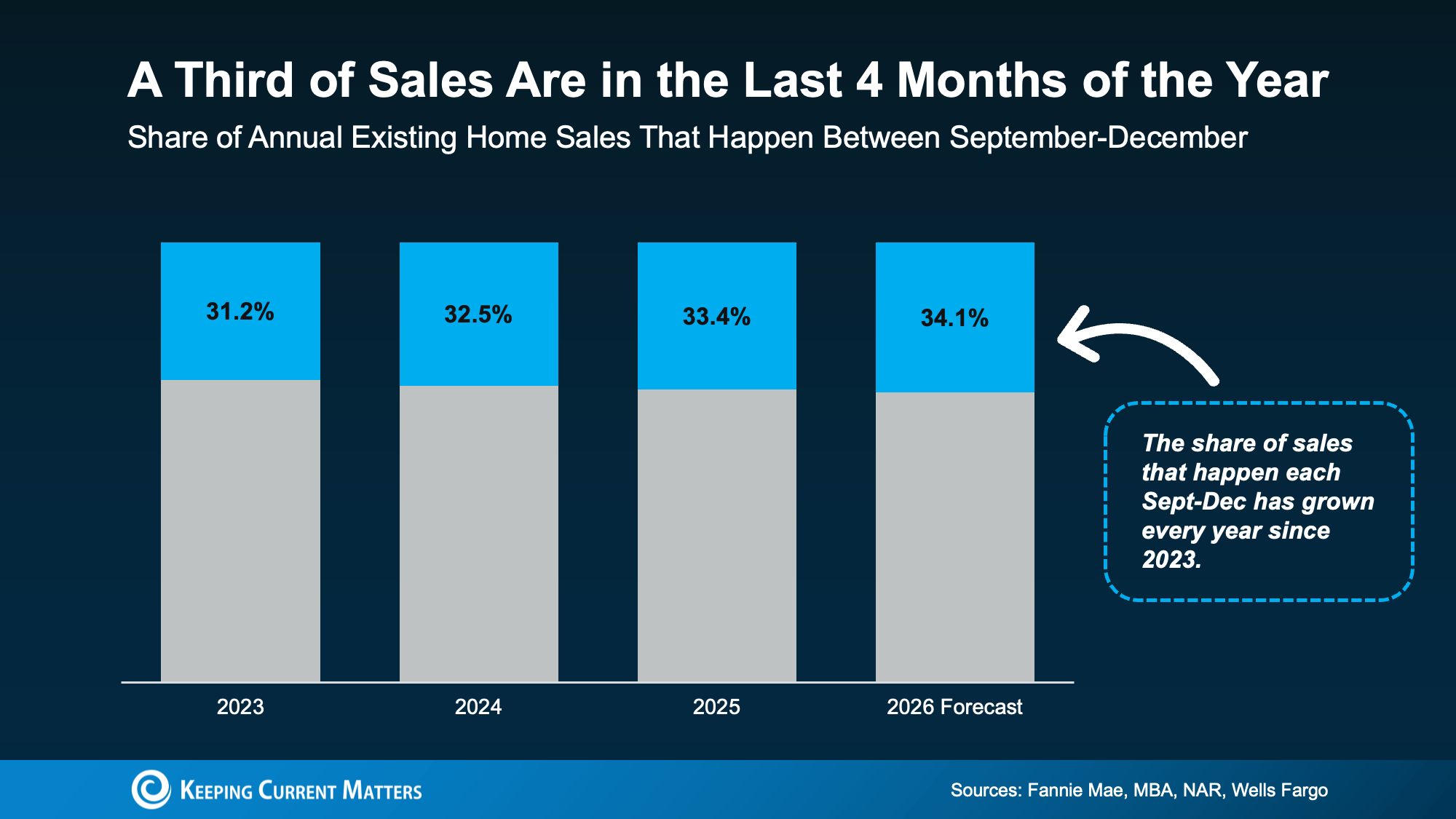
Not so fast. About one in three of all home sales happen in the last four months of the year.
Fall Is Busier than You Think
Data from the National Association of Realtors (NAR) shows around a third of existing home sales happen in the final four months of the year. And that share has grown every year since 2023 (see graph below):
Here’s What That Means for You
According to forecasts from Fannie Mae, the Mortgage Bankers Association (MBA), NAR, and Wells Fargo, there will be about 4.16 million existing home sales this year. Based on how many sales have happened so far, that means roughly 1.4 million sales are expected between now and December.
That’s about 11,800 houses selling every single day this fall.
So, the market isn’t frozen and you don’t need to put your plans on ice either. Yes, higher rates are keeping some buyers on the sidelines. But hold out for next spring, and you’ll sit out months when other serious buyers are ready to move before the new year.
How do you get in front of those buyers who are still out there looking right now? Getting your house sold this season comes down to how well it’s priced and presented, and that’s where a local agent shines.
A good agent knows what buyers in your area want right now, prices your house to match this fall’s market, and positions it to stand out to the serious buyers shopping before year-end. From the first photo to the final offer, they handle the details that turn your house on the market into one of the 11,800 selling every day.
Bottom Line
Listing this fall doesn’t mean your house will sit on the market until spring. Buyers are out there right now, ready to make a move before the new year – and your window is still open.
Start packing early to avoid underestimating the time it takes and reduce last-minute stress.
Pack items you use least, like seasonal clothes and decor, to streamline the process.
Save daily essentials for last so they’re easily accessible during and after the move.
Unless you’re doing a gut renovation yourself, doing your own packingfor a move might be the task that requires the most time and attention from any renter or homeowner.
“The biggest mistake people make is underestimating how long packing takes. Even a few months before your move is not too early to start,” says Lauren Pearl, professional organizer.
It’s such a time-intensive task (and one that most people underestimate), pro organizer Sandra Einstein recommends getting a quote from professional movers to find out the cost to pack half. “You can compromise and do half yourself and let them do the other half,” she says.
Whether you’re packing half or all yourself, our experts recommend packing these five items first, and saving these four items for last.
Lauren Pearl is the founder and CEO or Pearl Concierge Services, offering organizing, packing, and decluttering services.
Sandra Einstein is the founder of e=mc2 organizing & coaching consultants, inc., specializing in organizing and time management.
5 Items to Pack First
“The same principle applies throughout the house: pack what you use least first,” Pearl summarizes. “The essentials you use every day should be packed last.”
Serveware, Formal Dinnerware
Counter to what you might think, Pearl recommends starting in the kitchen.
“Take a break from hosting as your move approaches, and pack your formal dinnerware, glassware, and the large serving platters and bowls you use for entertaining first. You won’t need them, and they take time to wrap and pack properly,” Pearl says.
Serveware and nice dinnerware tops Einstein’s list as well. “China, silverware, good stainless steel or silver utensils,” she lists.
Seasonal Clothes
“Start with the things in your home you won’t be using in the timeframe before the move,” Einstein says. One of the top examples of this is seasonal clothing.” For example, if you’re moving in the dead of winter, you definitely won’t need your sun hat and linen pants for many months.
If your seasonal clothes are stored in plastic bins, you still might want to repack them in cardboard boxes. When the plastic bins are mixed into a tall stack of heavy cardboard boxes in the moving truck, the weight of the boxes could cause the plastic lids or boxes to crack.
The Guest Room
Similar to how you’re unlikely to be hosting a party in the weeks before moving, you’re unlikely to host guests.
“Items in the guest room can usually be packed well before moving day,” Pearl says.
If your extra linens (sheets, blankets, towels) aren’t kept the in guest room, you can pack those away too, says Einstein. Just be sure to keep enough out for you to use in the coming weeks.
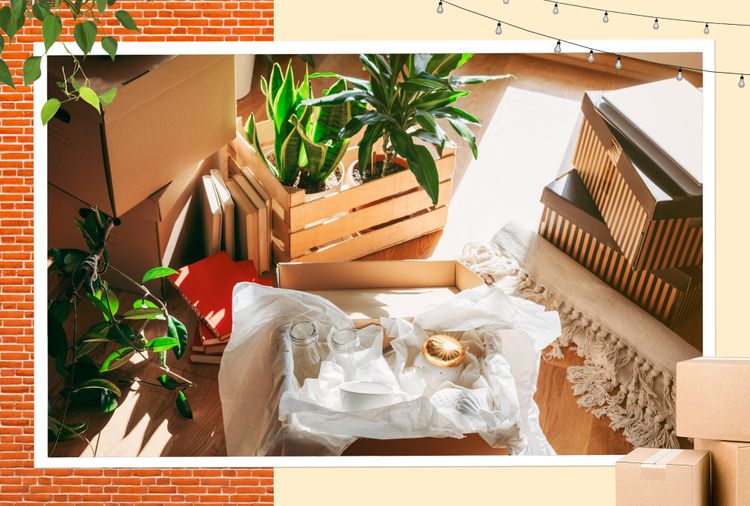
Books
The Spruce / Ana Maria Stanciu
Both organizers had books on their lists of items to pack first. Keep your current read and and your next book or two set aside and pack the rest.
Pearl recommends packing books in smaller boxes—the weight adds up quickly. “Even if movers will be doing the heavy lifting, you’ll probably end up moving boxes around yourself, and smaller, lighter boxes are easier to handle,” she says.
Decorative Items
Anything that’s decorative should be packed up.
“Knickknacks and any decorative items, such as vases and picture frames,” Einstein rattles off.
Although, if any of your decorative items are particularly valuable, like a notable piece of art or a piano, Einstein recommends having them professionally packed and, ideally, professionally moved.
4 Items to Pack Last
Valuables
“Keep valuable and irreplaceable items with you,” Pearl says. These are the items you don’t want to let out of your sight. Things like jewelry and passports.
“Important papers should go with you in the car or in a suitcase if [you’re] flying,” Einstein agrees. Anything that would require you to get in touch with a government service should be considered an important document: marriage license, birth certificate, title to your car, social security cards, etc.
“About a week before your move, set out a suitcase for these must-haves. As you think of things you use all the time and don’t want accidentally packed away, drop them into the suitcase. This way, everything you’ll need during the move and immediately afterward stays together,” Pearl says.
Cleaning Supplies
You’ll want to keep your detergents and cleaners set aside to do laundry and keep your house from becoming generally gross while you’re living there.
However, Einstein questions if you should be packing cleaning suppliesat all, since they can leak or damage your other possessions. She recommends considering how far you’re moving before packing the supplies up. If you’re moving long distance, it might give you peace of mind to buy cleaning supplies in your new location.
Some professional moving companies won’t even move cleaning supplies, as they’re considered hazardous materials. Ask your moving company for a list of what they won’t move.
There’s no point taking the time and energy to pack something (and possibly pay someone to move it) if you don’t want it. Take this as an opportunity to go through your possessions and give away or donate what you don’t plan to use in your new home.
“The less you move, the less you’ll have to unpack and deal with when you arrive,” Pearl says.
What Helps You Live Comfortably
Whatever you truly need on a daily basis should be packed last.
“These include your medications, everyday toiletries, chargers, clothing, and whatever else you need to comfortably get through the final days before your move and the first few days in your new home,” Pearl says.
Think of it like this: the things you pack last should be the first things you’ll want to unpack.
For example, Einstein recommends saving your everyday linens (towels, sheets), medications, and small household appliances, like a coffee pot or toaster, as the items to pack last.
4 Items to Set Aside to Have Accessible at Your New Place
Chris Evans has officially said goodbye to his serene Hollywood Hills retreat high above Mulholland Drive. Born and raised near Boston, the actor previously shared that he is offloading the property to spend more time with family on the East Coast.
First offered for sale in May 2025 with a nearly $7 million price tag, the home was relisted last June for $6.4 million before ultimately closing at the end of August for $5.385 million. The final figure sits about $1.86 million above what Evans originally paid for the hillside spread in spring 2013—just two years after launching his lucrative 11-film run as Captain America (aka Steve Rogers) in the Marvel Cinematic Universe.
The living room has large windows offering views of the lush greenery and rolling hills.Lawrence Fitz-Simon
Completed in the 1940s and since renovated, the beige stucco and stone structure is sequestered behind greenery-encased walls and security gates on three-quarters of an acre. Four bedrooms and half a dozen bathrooms are spread across roughly 4,600 square feet of split-level living space designed by Stewart-Gulrajani, with rustic hardwood floors, soaring exposed-beam ceilings, and large windows capturing scenic canyon and mountain views.
An elegant living room winds its way to a formal dining room with a wet bar, while a family room opens to an alfresco dining terrace via floor-to-ceiling glass doors. Nearby, a skylit kitchen has Bianca marble countertops and a 60-inch Wolf range beneath a custom 10-foot hood.
The backyard is anchored by a curved swimming pool and spillover spa.Lawrence Fitz-Simon
In addition to a secluded primary suite featuring a private ipe wood deck, dressing room, and limestone and Calacatta marble bath, other highlights include a one-bedroom guesthouse with a full kitchen, plus its own living and dining area. The custom in-house gym where Evans famously trained for his superhero roles has since been removed.
Vineyard-inspired gardens shaded by mature coral trees join a free-form pool and spillover spa, a fire pit lounge, and a trellised dining area. There’s also a lounging perch overlooking sweeping vistas of Mulholland and Laurel canyons and the Santa Monica Mountains beyond.
Scott Moore of Christie’s International Real Estate Southern California held the listing, with Kaitrin Simkin and Jenna Cooper of Compass representing the buyer.
You’ve been waiting for something to change before you buy. It just might not be the thing you expected…
While everyone’s paying attention to mortgage rates, only the savviest buyers know that the changing season can start tipping things in their favor.
Because every fall, buyers tend to get more to choose from, better prices, and more room to negotiate. And that’s why Hannah Jones, Senior Economist at Realtor.com,says:
“We always see that the best time to buy window usually falls in the early fall around October.”
And that’s exactly why, if you’ve been waiting for a better moment to buy, this season may be worth a closer look – even with rates where they are.
1. There Are More Homes To Choose From
One of the biggest frustrations buyers have had over the past few years has been a lack of choices. Fall tends to help with that.
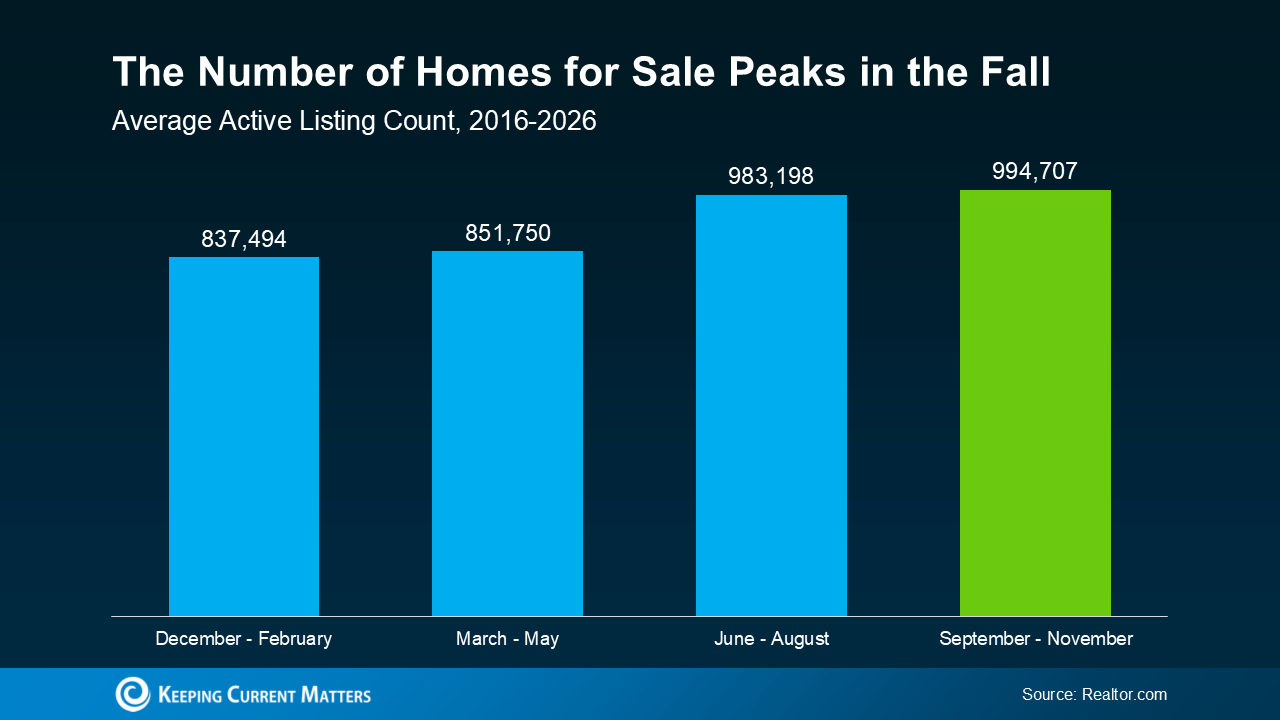
Based on seasonal trends, Realtor.comdata shows there are typically more homes available for sale in September through November than during any other season of the year (see graph below):
Why does this happen? Homes that hit the market in spring and summer don’t all close right away. Some sit. New listings keep coming. And inventory builds as the year goes on.
By fall, you’re looking at the largest pool of available homes all year. That makes it easier to find one that works for your needs and your budget. And if anything, this should be more true this year. Rates that are higher for longer tend to help inventory grow even more.
More choices can mean fewer compromises. You’re more likely to find the right home, not just the one that happens to be available.
2. Asking Prices Start To Drop
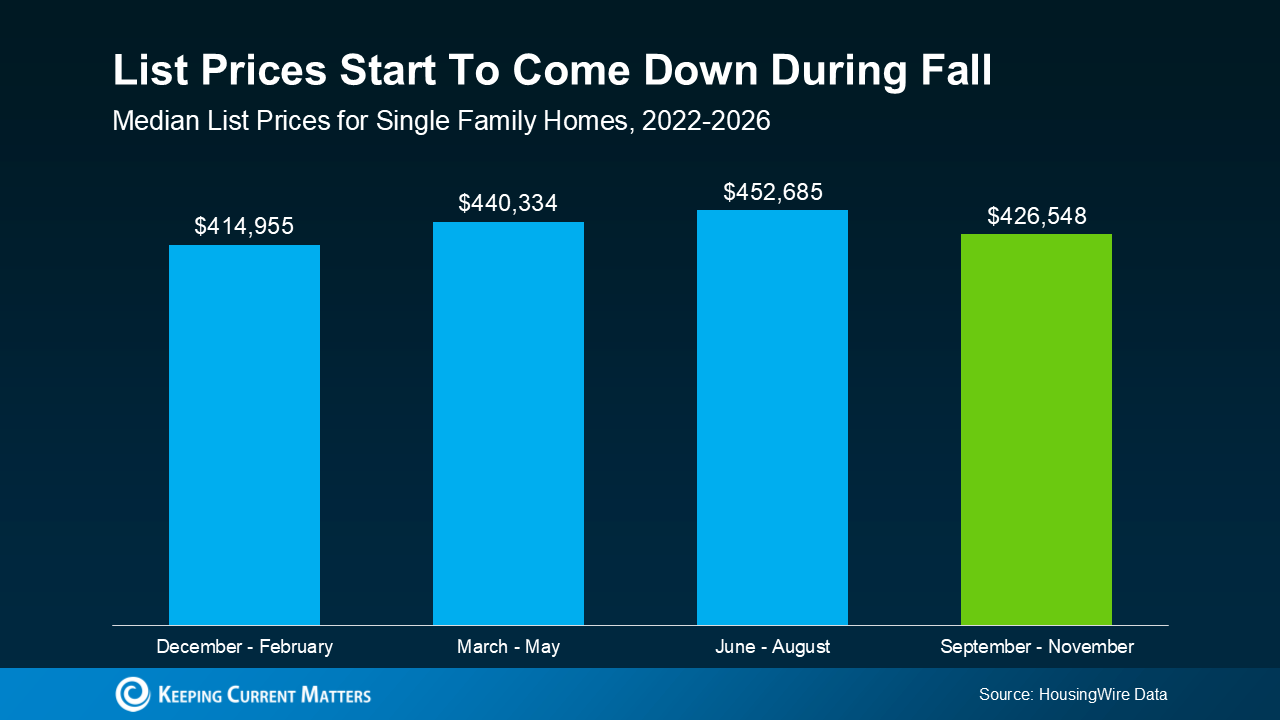
Having more choices is great. But if every home is still priced too high, that only gets you so far. That’s where fall’s second advantage kicks in: asking prices start their seasonal decline.
HousingWire data shows this trend over time (see graph below):
It works like this. Spring and early summer are when sellers feel the most confident because that’s when demand is typically strongest. So, many homeowners price their homes higher during those periods because of the uptick in demand.
But every year, like clockwork, that dynamic starts to change by fall. Buyer activity slows down as the weather cools off. So, sellers have to price a bit lower to try to draw buyers in. And that’s good for your bottom line.
3. More Sellers Are Willing To Negotiate
But fall doesn’t just bring more choices and lower asking prices. It also brings more sellers who are increasingly motivated to get a deal done.
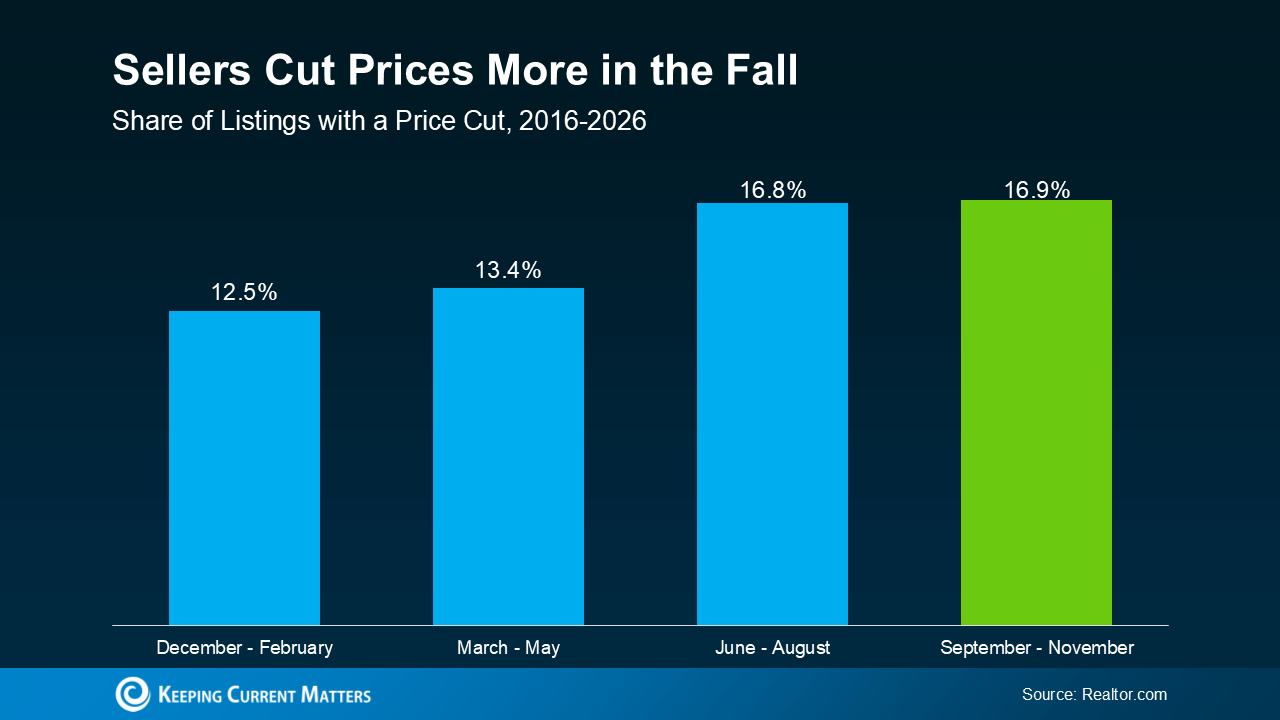
You can see it in the data. Most years, fall is when price cuts peak according to Realtor.comdata (see graph below):
While it’s not a big difference from summer, this fall you’ll have more negotiation power than you’d have if you wait until the first half of 2027. Here’s why.
If a home is on the market in the fall, many sellers are eager to get it sold before the holidays. And since there are usually fewer buyers active in the fall, that often leads to another opportunity to snag a better deal. As the National Association of Realtors (NAR) explains:
“Less competition can lead to better deals. While homes are not selling as fast as during the summer, sellers may be more willing to negotiate.”
Even a small seller compromise here can make a meaningful difference for you.
As an example, a 5% price drop on a $500,000 home is $25,000. That could mean you end up borrowing less, keeping more money in savings, having room in the budget for updates after you move in, or simply making the monthly payment feel more manageable.
Bottom Line
Of course, every market moves a little differently. But here’s what doesn’t change: Fall consistently buyers. More homes. Lower asking prices. Motivated sellers.
If you’ve been waiting for your search to feel a little more doable, this season may be worth another look.
Have a quick conversation with a local agent about what’s happening in your market. That way you can find out whether this fall gives you opportunities you may not have had a few months ago.
Paprika, onion powder, garlic powder, salt, and olive oil. Let it hang out while you prep the other stuff.
Step 2: Make a Cucumber Tomato Salad
Cucumbers, tomatoes, red onion, and a tiny bit of olive oil, salt, and vinegar.
Step 3: Make Pepperoncini Garlic Butter Sauce
Garlic, melted butter, pepperoncini brine, and some pepperoncini peppers get mixed up to make a sauce.
Step 4: Grill the Chicken
I usually use a grill pan because I’m too lazy to get my grill out. But an actual grill (or a regular skillet) will work perfectly.
Step 5: Assemble
This is the fun part! Hummus goes first, then tomato cucumber salad, then chicken and sauce.
Finish it off with feta and chives!
Lindsay’s Notes
Grilled marinated chicken, tomato cucumber salad, feta, hummus, and a pepperoncini garlic butter sauce. OH BABY, I love this recipe!
I got the idea for this from Sara Tane – got to her site randomly via Threads (okay Threads! coming in clutch with recipe inspo!) and immediately knew it was going to be a banger.
This particular grilled marinated chicken is so simple (just dry spices and olive oil) and yet somehow so good. I honestly think the biggest challenge of this recipe is trying not to eat all of the chicken before it makes its way onto the plate.
And as if that wasn’t enough, get it all laced up with some freshly grated garlic, melted butter, and pepperoncini brine and you’ve got one killer combo.
Watch How To Make This Grilled Chicken with Pepperoncini
Grilled Chicken With Pepperoncini Garlic Butter
5 Stars4 Stars3 Stars2 Stars1 Star
5 from 73 reviews
TOTAL TIME:35 minutes
YIELD:4 servings 1x
This is such a fun one! Grilled marinated chicken, a quick tomato cucumber salad, tangy bits of feta, and a zippy pepperoncini garlic butter sauce poured over the whole thing.
INGREDIENTS
Grilled Chicken:
1 teaspoongarlic powder
1 teaspoononion powder
1 teaspoonpaprika
1 teaspoon coarse kosher salt
1lb. chicken breasts
1 tablespoonolive oil
Pepperoncini Butter Sauce:
6 tablespoons butter
1 clove garlic, minced
1/4cup pepperoncini brine
1/4 to 1/2cuppepperoncinis, chopped
Cucumber Salad:
1pintcherry or grape tomatoes, halved
half acucumber, chopped
a quarter of a red onion, minced or thinly sliced
salt and pepper, olive oil, vinegar
Extras:
Chives
Feta
Hummus
Pita Bread
INSTRUCTIONS
Marinate the Chicken: Place the chicken, spices, and olive oil together in a large bowl or plastic bag. Mix until well-coated; set aside in the fridge while you prep the other elements (30 minutes up to several hours).
Make the Cucumber Salad: Toss veggies with a small amount of salt, pepper, olive oil, and vinegar. (If you add too much it becomes watery, so use a light hand!)
Make the Pepperoncini Butter Sauce: Melt the butter (I just do this in the microwave). Stir in the garlic, brine, and pepperoncini pieces. Set aside.
Grill the Chicken: Using a grill, grill pan, or skillet, cook the chicken until cooked through and golden brown on both sides. If you have a meat thermometer, I highly recommend using it so you don’t overcook the chicken! We’re looking for 160 degrees. Let it rest for a moment, then cut into slices.
Assemble: If you want to serve it as a family-style meal – layer the hummus on a large platter. Add the cucumber salad in 3-4 little mounds around the outside of the plate. Add the chicken right in the middle and drizzle with the pepperoncini butter sauce. Add feta, chives, and s&p to finish. Scoop onto plates or dip into the whole thing with pita bread. SO good!
LeBron James entered the NBA in 2003 as the No. 1 overall pick and has since built one of the most decorated careers in sports history. The Ohio native has won four NBA championships, four MVP awards, and four Finals MVPs, while becoming the league’s all-time leading scorer. In 2026, he added another record to the list, becoming the first player to surpass 50,000 combined regular-season and playoff points. At 41, he is still playing, recently signing a two-year, $8 million deal with the Philadelphia 76ers.
Basketball, however, is only one piece of the King James portfolio. He became the first active NBA player to reach billionaire status, with investments spanning entertainment, sports, and consumer brands. With longtime partner Maverick Carter, he founded The SpringHill Company; in 2021, he took a stake in Fenway Sports Group, which owns the Boston Red Sox and Liverpool F.C.; and he’s also a strategic investor in the PGA Tour alongside Drake. Off the court, he has built a notable collection of luxury cars and watches, including a personalized Mercedes-Maybach S 680 and pieces from Richard Mille, Audemars Piguet, Patek Philippe, and Rolex.
Over the years, the family has lived across the country, buying and selling homes as James’s career evolved. The properties include a custom-built Ohio compound, a waterfront Miami mansion he sold after his Heat years, two Brentwood estates, and a Beverly Hills property that he is now redeveloping from the ground up. Altogether, the homes trace the major chapters of James’s career, from teenage phenom to NBA veteran and businessman.
Akron, Ohio
Photo : Google Earth
James’s first major real estate purchase came not long after the Cleveland Cavaliers made him the No. 1 pick in the 2003 NBA draft. At 18, he reportedly paid $2.1 million for a property in Bath Township, just northwest of Akron, then tore down the existing house and built a custom mansion. The roughly 30,000-square-foot estate sits on about seven acres and has six bedrooms, eight full bathrooms, and six half-bathrooms. It also has a two-lane bowling alley, recording studio, home theater, aquarium, sports bar, and full barbershop. The primary suite comes with a two-story walk-in closet.
James expanded the property a few years later, paying $425,000 in 2006 for an adjacent parcel with a five-bedroom, two-and-a-half-bathroom house. In 2012, an LLC linked to James bought another Akron home for $220,000. The roughly three-bedroom house, about a quarter-mile from the main estate, was reportedly intended for his mother, Gloria. James has kept his Akron properties through his moves to Miami and Los Angeles, with the main estate now estimated to be worth about $9.2 million.
Coconut Grove, Miami
Photo : Google Earth
When James joined the Heat in 2010, he picked up a waterfront home in Miami’s Coconut Grove area. He paid $9 million for the custom-built mansion, a steep discount from its $11.9 million asking price. The nearly 16,000-square-foot house has six bedrooms and plenty of room for relaxing and entertaining, including an eight-seat theater, wine cellar, billiards and poker rooms, along with a pool with a swim-up bar and multicolored LED lighting. The primary suite opens onto a private waterfront balcony, while a separate guesthouse sits above a three-car garage and the private dock accommodates two 60-foot boats.
James lived there throughout his four seasons with the Heat, during which he won two NBA championships and two MVP awards. After returning to Cleveland in 2014, he listed the house for $17 million and later cut the asking price to $15 million. It sold in August 2015 for $13.4 million, a substantial return on his investment.
Brentwood, Los Angeles — First Home
Photo : Google Earth
James bought his first home in Los Angeles in 2015, paying $21 million for a 9,440-square-foot Colonial-style house in the Brentwood area, records show. The six-bedroom, eight-bathroom mansion has a double-height foyer, a wood-paneled office, and a home gym, while the outdoor spaces offer multiple patios and an infinity-edge pool that stretches nearly the width of the house. Naturally, there was also a basketball court.
James kept the property through his return to the Cleveland Cavaliers in 2014 and their 2016 championship season before putting it on the market in early 2021 for $20.5 million, selling it later in the year for $19.6 million.
Brentwood, Los Angeles — Second Home
Photo : Google Earth
Two years after buying his first Brentwood house, James supersized. Records show he paid roughly $23.5 million for a newly built spec mansion in late 2017, shortly before signing with the Los Angeles Lakers in 2018.
At nearly 16,000 square feet, the contemporary estate has eight bedrooms and 11 bathrooms. The house also has a 1,500-bottle wine cellar, theater, cigar room with air-purifying technology, onyx bar, and elevator. An indoor-outdoor gym connects to a spa with a steam room, shower, sauna, and massage room, while marble-lined covered patios lead to a rooftop terrace.
Beverly Hills, California
Photo : Google Earth
In September 2020, James paid about $36.75 million for a 2.5-acre Beverly Hills estate that had been listed for $39 million. The roughly 13,000-square-foot Mediterranean-style property is steeped in Hollywood history. Built in the 1930s, it was once owned by actor Charles Boyer; Howard Hughes later acquired the property and reportedly leased it to Katharine Hepburn. It was eventually owned by Lee Phillip Bell and William J. Bell, the creators of The Young and the Restless and The Bold and the Beautiful.
The original compound had a four-bedroom main house, two detached guesthouses, a screening room, a lighted tennis court, a pool house, and an oval swimming pool. James, however, had bigger plans for the property. In June 2023, he demolished the existing structures and began building a new compound from the ground up.
Plans call for two separate residences with a shared driveway and motor court, a guard-gated entrance, and 10-foot security fencing. The main house will span roughly 16,000 square feet over two stories, with a 7,700-square-foot basement garage, pool and spa, outdoor kitchen, and solar panels. A second, 6,550-square-foot single-story residence will include a basement theater, expansive terrace, hot and cold plunge pools, and a palm-filled courtyard.
Sunny Isles Beach, Florida
Photo : Jeffrey Greenberg/Universal Images Group via Getty Images
James returned to South Florida in October 2022, reportedly paying $9 million for a condo at Estates at Acqualina in Sunny Isles Beach, just north of Miami Beach. The Trump Group, the developer behind the project, sold the Collins Avenue unit to a company managed by James and linked to his Akron-based LeBron James Family Foundation. The unit is one of 154 within the development’s 49-story south tower.
Not much is publicly known about the specific unit, but the building itself is decidedly over-the-top. The residential lobbies were designed by the late Karl Lagerfeld and a 45,000-square-foot amenities villa includes an ice-skating rink, bowling alley, and movie theater.


 Facebook
 X
X
 Pinterest
 Copy Link










:max_bytes(150000):strip_icc()/pack-and-move-books-2436599-04-2db7a0295deb47d7b9ab7529e84a5ac3.jpg)
:max_bytes(150000):strip_icc()/GettyImages-1989437144-9b9d825876e046caa4a69c659efe5ef8.jpg)



 Why does this happen? Homes that hit the market in spring and summer don’t all close right away. Some sit. New listings keep coming. And
  It works like this. Spring and early summer are when sellers feel the most confident because that’s when demand is typically strongest. So, many homeowners price their homes higher during those periods because of the uptick in demand.