

 Facebook
 X
X
 Pinterest
 Copy Link
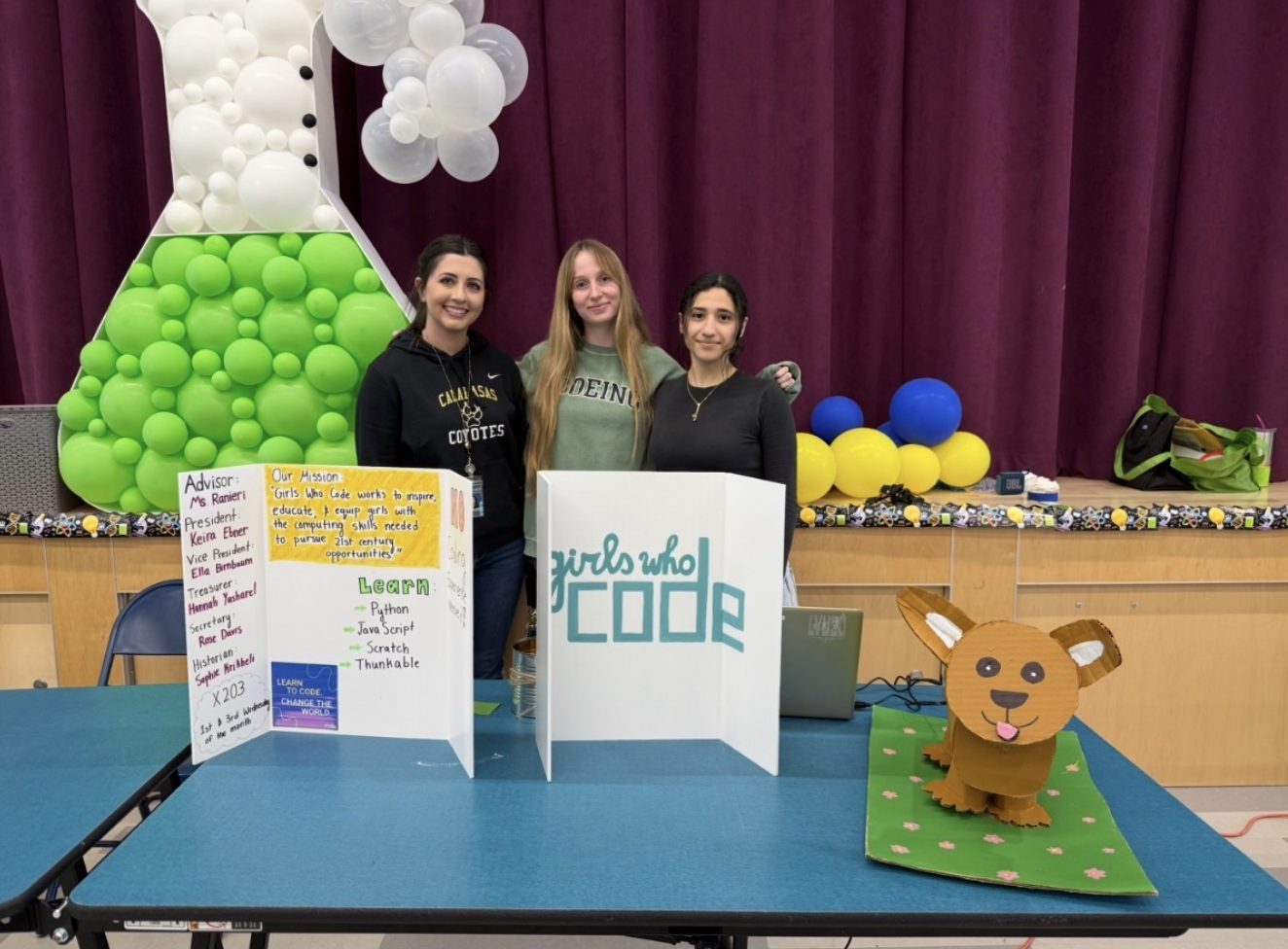
For any women interested in STEM, the scales of the male-dominated field can seem incredibly tipped, with national data continuing to show that men occupy a significant majority of such roles in the United States. At Calabasas High School, students are working to shift that trajectory. The Girls Who Code Club, a chapter of the Girls Who Code organization, aims to teach coding while dismantling the intimidation that often surrounds STEM fields. Through outreach events at local elementary and middle schools and biweekly meetings, the club introduces students to programming concepts, robotics, and the wide range of STEM careers. These events consist of showing students different aspects of coding and sharing information about STEM-related careers.
“We want to help women find science-related careers that they might be passionate about. We mostly based our club on coding, but it isn’t just for coding; it is for all STEM-related topics and material,” said Ella Birnbaum, vice president of Girls Who Code and senior at CHS.
The club’s work reflects a broader pattern of underrepresentation in classrooms. For club president Keira Ebner, the realization came from personal experience.
“I’ve kind of noticed, as I have taken more advanced STEM classes, that there haven’t been that many girls taking those classes with me. I wanted to help inspire them in case there was something limiting them from taking those classes.”
That observation led the club to focus its efforts on younger students, aiming to build interest in STEM even before those gaps could form.
“We give them the background of what coding is, and different platforms that they can learn coding with. Then we give them a tutorial on how to build a fun game to get them engaged. Recently, we’ve been bringing more robotic things that they can interact with,” said Ebner.
These events at A. E. Wright Middle School, Chaparral Elementary, and Lupin Hill Elementary have left a lasting impact on students, leaving them eager to continue exploring.
“We’ve talked to a couple of different people who are interested in joining the club once they do get to a high school level. We did catch a lot of people’s eyes, and I think that we definitely helped motivate women to continue to grow,” said Birnbaum.
“I think it definitely has left an impact because I think I’ve already seen some girls interested in what we were doing, and they asked at the end, ‘what is this club called?’ or ‘how can I be a part of this?’” said Ebner.
The club itself, however, has not been immune to challenges. Recruiting and maintaining membership remains an ongoing challenge as it works to sustain participation and expand its reach.
“We haven’t been as active this semester, since we’ve had a little bit of trouble finding members,” said Ebner.
Even so, the organization has grown from two founders into a structured leadership board. Despite any evolutions, the club’s goals of making STEM more accessible and empowering women remain clear.
“As I’ve gotten older, there have been some stigmas surrounding what I do, and people might think I’m not as capable as I am at doing technical things. So I just hope that we can limit that feeling,” said Ebner.
While also gaining knowledge about coding, students also find themselves learning valuable lessons and going through journeys that can be carried past high school.
“I would definitely say when we brought the robot to A. E. Wright, and presented it at that school, seeing all the younger students be able to explore how to code was definitely inspiring. It made me reflect back on when I first realized I wanted to go into STEM, and how my passion has grown since that first moment,” said Birnbaum.
The amount of planning and setting up events can also provide students with valuable skills.
“It definitely taught me how to be resilient because I know as a high schooler, it’s a little bit difficult to organize events like this,” said Ebner. “I know some things can be a little bit frustrating, whether that be the kind of people around you, attitudes towards you, or coding itself can be a little bit frustrating sometimes, but don’t give up and don’t be afraid to step out of your comfort zone.”
Those experiences reflect the broader requirements of STEM fields, where persistence plays a central role.
As both the club president and vice president prepare to graduate, the future of the club remains uncertain. Its continuation depends on a new group of students hoping to carry on with its mission.
“I really hope the club continues because I think it’s like such an amazing opportunity, and there are so many amazing resources out there that support people’s interests. I really hope that there will be someone who wants to take that over and be willing to organize events like that once I graduate,” said Ebner.
“We want to continue spreading this awareness to other schools so that other students can explore STEM and continue to grow, even around the world,” adds Birnbaum.
–,

